
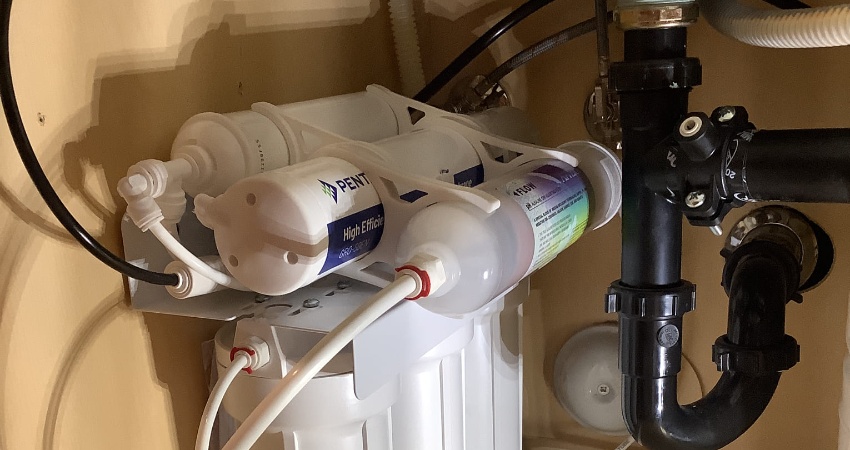
Most home water filtration systems require periodic filter changes, while reverse osmosis (RO) membranes and water softener resin typically last several years. Slow water flow, changes in taste, leaks, or declining filtration performance can signal that it’s past time for water filter replacement or maintenance is needed.
In Glendale neighborhoods such as Arrowhead Ranch, Hillcrest Ranch, and Arrowhead Lakes, many homes date to the 1980s and 1990s. Some homeowners have inherited under-sink RO systems, whole-house filters, or water softeners from previous owners without knowing when they were last serviced.
Understanding the proper timing for whole-house water filter replacement, under sink water filter replacement, RO system filter changes, and water filtration repair in Glendale, AZ can help you keep your system working properly.
How Glendale’s Water Supply Affects Home Filtration Systems
Glendale relies on several water sources to serve residents. According to the city’s Water Services Department, its supply includes renewable surface water from the Salt, Verde, and Colorado rivers, along with stored water credits earned through groundwater recharge programs.
Glendale’s primary water resources include:
- Salt River Project (SRP): Supplies water originating from snowmelt and rainfall in the Salt and Verde River watersheds.
- Central Arizona Project (CAP): Delivers Colorado River water stored in reservoirs, including Lake Powell, Lake Mead, and Lake Pleasant.
- Groundwater: Provides a limited supplemental supply when needed.
- Reclaimed water: Treated wastewater used for non-potable purposes, including landscaping and certain industrial applications.
Because water comes from multiple sources, mineral concentrations and other characteristics can vary within Glendale’s distribution system. The Glendale 2025 Water Quality Report, published in 2026, identifies hardness levels ranging from 5.4 to 18.5 grains per gallon, averaging 13.8 grains per gallon. That means the water here is classified as hard to very hard, containing dissolved calcium and magnesium that can form mineral deposits inside plumbing and appliances. These minerals can also contribute to scaling on a reverse osmosis membrane.
Water Filter Replacement Schedule: How Often Should You Change Each Component?
Different filtration components have different service lives. A sediment cartridge that captures suspended particles may need replacement several times before a reverse osmosis membrane reaches the end of its useful life.
Here is a general maintenance guide, although your situation may be different. It’s always a good idea to follow your manufacturer’s guidelines. We checked several of the more common type of water filtration units.
| Component | APEC | iSpring | Culligan | Pentair / Everpure | Watts Premier |
| Sediment | 6–12 months | 6–12 months | 6–12 months, up to 1–2 years with select cartridges | 6–12 months | 6 months |
| Carbon prefilter | 6–12 months | 6–12 months | 6–12 months, up to 1–2 years | 6–12 months | All non-membrane filters about once a year |
| RO membrane | 2-3 years | Every 2 years | 2–3 years generally, 3–5 years for Culligan’s membranes | Replace after 18–24 months | 2–5 years |
| Post-carbon | 3–5 years | 6–12 months | 1 year/1,000 gal or 2 years/2,000 gal | 6–12 months | Yearly |
These intervals are guidelines, not strict requirements. Some filters have a rated gallon capacity in addition to a recommended replacement period. Others require replacement when pressure loss or declining treatment performance indicates that their useful life has ended.
Make sure when you’re shopping for a water filter replacement cartridge, component, or membrane to match the part with your model. Replacing the wrong component or using an incompatible cartridge can compromise performance, potentially causing leaks and voiding any warranty.
Common Signs Your Water Filtration System Needs Repair
Filtration problems do not always mean the filters themselves have failed. Water pressure, plumbing connections, control valves, and other components can produce similar symptoms. Here’s some things to check for that may indicate it’s time for water filtration repair in Glendale, AZ.
Low Water Pressure or Slow Flow
A weakening stream from an RO faucet may indicate clogged prefilters, a restricted membrane, or insufficient incoming water pressure.
Tank-based systems have additional potential problems. A storage tank with an inadequate air charge or failed internal bladder may deliver water slowly even when the filters are functioning properly.
Whole-house systems can also restrict water pressure when cartridges become heavily loaded with sediment. If pressure declines throughout the home, the filtration equipment may be one of several possible causes.
Changes in Water Taste, Odor, or Appearance
Activated carbon filters help reduce chlorine taste and certain other substances. When they exceed their rated capacity, treatment performance may decline. Improperly seated cartridges can also allow water to bypass the intended filtration media.
Changes in taste or odor do not automatically indicate contamination. However, persistent or unexplained changes warrant investigation, particularly when accompanied by discoloration or other unusual conditions.
Leaks, Noises, or Constant Drain Flow
These situations typically indicate a problem that needs professional evaluation:
- A leaking filtration system may have deteriorated O-rings, cracked housings, loose fittings, or damaged tubing.
- An RO system that continuously sends water to the drain may have a malfunctioning shutoff valve, flow-control problem, or another issue preventing normal operation.
- Tankless systems with booster pumps can also develop electrical or mechanical problems.
Active leaks should be addressed promptly to prevent water damage to cabinets, walls, and flooring.
Reverse Osmosis Filter Replacement vs. Membrane Replacement
Reverse osmosis systems use multiple filtration stages, and each serves a different purpose.
When to Replace RO Prefilters
Most residential RO systems include sediment and carbon prefilters.
Sediment cartridges capture suspended particles, while carbon prefilters reduce substances such as chlorine that can damage certain membrane materials. Routine reverse osmosis filter replacement helps maintain water production and protects downstream components.
Neglecting prefilters can shorten membrane life, even when the membrane itself has not reached its expected replacement interval.
How to Recognize a Failing RO Membrane
The reverse osmosis membrane separates many dissolved minerals and other substances from drinking water. When it becomes fouled or scaled, filtered-water production may decline. A deteriorating membrane may also allow more dissolved substances through.
Technicians can compare total dissolved solids (TDS) measurements in untreated and treated water to evaluate membrane rejection performance. However, TDS readings alone cannot establish whether drinking water is safe or whether specific contaminants are being adequately removed. A membrane should be evaluated when treatment performance falls below manufacturer specifications, particularly after prefilter problems and water pressure have been ruled out.
Can You Replace Filters Without Replacing the Membrane?
Yes. Routine prefilter changes generally occur much more frequently than membrane replacements.
An RO system filter change may involve replacing only sediment and carbon cartridges while retaining a properly functioning membrane.
Whole-House Water Filter Replacement vs. Under-Sink Water Filter Replacement
Whole-house and under-sink systems serve different purposes, which affects their maintenance requirements.
Whole-House Filtration Systems
Whole-house filtration equipment treats water entering your home’s plumbing system. Depending on its design, it may use sediment cartridges, activated carbon water filter replacement cartridges or large media tanks.
Whole-house water filter replacement schedules depend on the equipment. Cartridge-based systems may require service every few months, while certain large media tanks may operate for several years before media replacement.
Because these systems handle water for multiple fixtures, clogged filters can affect pressure throughout the home, so you should monitor flow restrictions and follow manufacturer specifications.
Under-Sink Filtration Systems
Under-sink filters typically treat drinking and cooking water at a dedicated faucet. Their smaller cartridges are often relatively straightforward to service.
However, under sink water filter replacement requires selecting compatible cartridges, properly seating seals, and checking connections for leaks. An incorrect water filter replacement cartridge may fit inside a housing but fail to provide the intended filtration performance.
RO systems add further complexity because they incorporate membranes, drain connections, and sometimes pressurized storage tanks or booster pumps.
How Hard Water Accelerates Wear on Glendale Filtration Equipment
Glendale’s hard water presents particular challenges for RO systems and water-using appliances. The severity depends on several factors, including hardness concentration, feedwater chemistry, membrane design, and system recovery rate.
Not every filter is affected in the same way:
- Sediment filters remove suspended particles but generally cannot remove dissolved hardness minerals.
- Carbon filters primarily target specific contaminants and aesthetic concerns rather than hardness.
- RO membranes can remove dissolved minerals but may develop scale when water conditions are unfavorable.
- Water softeners remove calcium and magnesium through ion exchange, helping reduce scale formation.
In some installations, an upstream water softener can protect RO equipment from excessive hardness. However, not every household requires one. For older Glendale homes, new filtration equipment also will not automatically eliminate decades of mineral scale that’s already built up in your water heater, pipes, or fixtures.
Should You Repair Your Existing Water Filter or Replace the Entire System?
Not every filtration problem requires purchasing new equipment. In many cases, replacing a worn component restores normal operation.
Consider repairs or routine servicing when:
- Filters are overdue for replacement.
- The system has a relatively minor leak involving a replaceable fitting or seal.
- Replacement cartridges and parts remain available.
- Water pressure and filtration performance improve after maintenance.
- The equipment is otherwise in good condition.
Consider replacing the system when:
- Filter housings are cracked or deteriorating.
- Multiple components have failed.
- Replacement parts are obsolete or unavailable.
- Repairs have become frequent.
- The existing system no longer meets household filtration needs.
For example, a properly functioning RO system with an exhausted carbon cartridge may need only a water filter replacement cartridge. By contrast, an older system with a failed storage tank, leaking housings, and declining membrane performance may be a better candidate for replacement.
A professional inspection can help identify the most economical approach.
A Practical Maintenance Checklist for Arrowhead-Area Homeowners With Water Filtration Systems
Homeowners in Arrowhead Ranch, Hillcrest Ranch, Arrowhead Lakes, and nearby Glendale neighborhoods can use a simple maintenance checklist to keep filtration equipment functioning properly.
- Identify the equipment. Locate the manufacturer, model number, and installation date if available.
- Review replacement schedules. Consult manufacturer instructions for cartridge and membrane service intervals.
- Record maintenance dates. Keep track of cartridge changes and repairs.
- Inspect visible components. Look for leaks, loose tubing, and deteriorating fittings.
- Monitor water flow. Notice changes in pressure or the time required to fill a glass.
- Check RO performance. Use appropriate testing to evaluate filtration and membrane condition.
- Inspect water softeners. Verify salt levels, regeneration settings, and treated-water hardness.
- Schedule service when necessary. Persistent symptoms may require professional diagnosis.
For homeowners who inherited unfamiliar equipment from a previous owner, a baseline inspection can establish its condition and help create a reliable maintenance schedule.
FAQS — Frequently Asked Questions About Water Filter Replacement
How often should I replace my reverse osmosis filters?
Many RO systems require sediment and carbon prefilter replacement every six to twelve months, although manufacturer recommendations vary. Membranes often last two to five years. Water quality, usage, and equipment design determine the appropriate schedule. Regular reverse osmosis filter replacement helps protect membrane performance and maintain consistent filtration.
Can hard water damage a reverse osmosis membrane?
Yes. Calcium and magnesium can contribute to mineral scale on membrane surfaces. As deposits accumulate, water production may decrease and filtration efficiency can suffer. Proper pretreatment, timely maintenance, and appropriate system settings help reduce scaling. A declining membrane should be evaluated before replacement because low water production can have other causes.
Why is my RO system producing water so slowly?
Slow RO water production may result from clogged prefilters, insufficient incoming pressure, membrane fouling, or problems with a pressurized storage tank. Restricted tubing and malfunctioning valves can also affect performance. A technician can test individual components to determine whether an RO system filter change, tank repair, or another service is necessary.
Is it worth repairing an older water filtration system?
Repairing an older system can make sense when the problem involves replaceable cartridges, fittings, or other accessible components. However, repeated leaks, obsolete parts, or multiple failures may justify replacement.
Professional Water Filtration Repair in Glendale’s Arrowhead Area
Reliable filtration depends on more than replacing cartridges on a calendar schedule. Homeowners should also consider water chemistry, equipment age, membrane performance, and the condition of plumbing connections.
For residents of Arrowhead Ranch, Hillcrest Ranch, Arrowhead Lakes, Marshall Ranch, and surrounding neighborhoods, professional service can help identify problems before they lead to more expensive repairs. Whether your system needs routine maintenance, whole-house water filter replacement, or a water filtration repair in Glendale, AZ, an experienced plumbing professional can evaluate the equipment and recommend appropriate solutions.
Contact George Brazil Plumbing & Electrical for professional water filtration repair in Glendale, AZ. We offer same-day service and transparent, upfront pricing.