
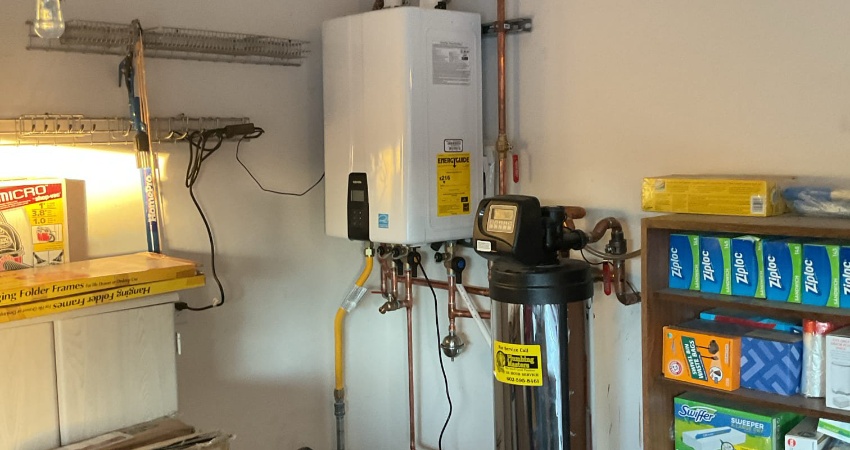
A water softener removes calcium and magnesium from Scottsdale’s hard water, while a water conditioner generally leaves those minerals in place but reduces their ability to form scale. Both approaches can help protect your household plumbing, but they deliver different results.
With Scottsdale’s water measuring approximately 13 to 17 grains per gallon in many areas, comparing a water conditioner vs. a water softener can help you choose the right treatment system.
How Hard Is Scottsdale’s Water?
Scottsdale’s water contains naturally occurring calcium and magnesium that accumulate as water travels through rivers, reservoirs, and underground aquifers. These minerals are not considered a health risk, but their concentration determines water hardness.
According to Scottsdale Water’s 2026 Water Quality Report, hardness varies a bit depending on where you live.
| Scottsdale Location | Hardness (Grains per Gallon) |
| South of Indian School Road | 13–15 |
| Indian School Road to Chaparral Road | 13–17 |
| North of Chaparral Road | 13–17 |
These measurements place Scottsdale’s water in the very hard category.
The city treats drinking water to meet applicable safety standards but does not remove hardness minerals throughout its municipal distribution system. Homeowners who want to address hardness must generally install their own treatment equipment.
What Does a Water Softener Do?
Traditional water softeners use ion exchange to remove calcium and magnesium from the water supply. As hard water passes through a resin tank, the resin captures hardness minerals and exchanges them for sodium or potassium ions. Every so often, the system regenerates the resin using a concentrated salt solution, flushing accumulated minerals into the drain.
This process produces genuinely softened water and offers several practical benefits:
- Improved performance from soaps and detergents
- Reduced mineral accumulation inside plumbing fixtures
- Less scale formation in water heaters and appliances
- Reduced interference from hardness minerals during household cleaning
For Scottsdale homeowners, conventional softening can provide comprehensive hardness removal throughout the house. However, salt-based systems require regular salt replenishment, periodic maintenance, and water for regeneration. They also discharge salt-containing wastewater, an important consideration in a desert community that emphasizes water conservation and reuse.
What Does a Water Conditioner Do?
Unlike traditional softeners, most salt-free conditioners do not physically remove hardness minerals. A common technology, template-assisted crystallization (TAC), encourages dissolved calcium and magnesium to form microscopic crystals that are less likely to attach to plumbing surfaces. The minerals remain in the water, but their tendency to form hard scale can be reduced.
You will get different results. Soap and detergent performance may remain largely unchanged, and water hardness measurements will generally be similar before and after treatment. On the other hand, most salt-free conditioning systems do not require salt replenishment or regeneration cycles. They also avoid the wastewater discharge associated with conventional softening.
A water conditioner can be an appropriate option for Scottsdale households primarily interested in scale management rather than complete mineral removal.
Water Conditioner vs Water Softener: What Does the EPA Recommend?
The EPA’s WaterSense Guide to Selecting Water Treatment Systems recommends selecting equipment certified to the appropriate performance standard, depending on your needs:
- NSF/ANSI 44: Covers traditional water softeners that remove hardness minerals.
- IAPMO/ANSI Z601: Addresses devices designed to reduce scale formation.
The EPA also recommends considering water efficiency and maintenance requirements when choosing treatment equipment.
Which System Makes More Sense for Scottsdale Homes?
Although Scottsdale’s water hardness is consistently high, different households have different treatment priorities.
When a Water Softener Is the Better Choice
Traditional softening is generally preferable when you want to reduce water hardness. For example, a household with several bathrooms, frequent laundry loads, and high hot-water consumption may benefit from removing calcium and magnesium before water reaches fixtures and appliances.
Homeowners replacing an older salt-based system may also prefer upgrading to a more efficient model rather than changing treatment technologies.
When a Water Conditioner Makes More Sense
Conditioning may be sufficient when the primary objective is reducing mineral scale without using salt or producing regeneration wastewater. For homeowners who prefer minimal routine maintenance, eliminating salt deliveries and regeneration cycles can be appealing.
However, not every conditioning technology performs equally well. Water chemistry, system design, and manufacturer specifications influence effectiveness, making professional equipment selection important.
Choosing the Right Water Filtration System for Your Scottsdale Home
Scottsdale’s consistent hardness levels make water treatment worth considering, but hardness alone does not determine which technology is best. George Brazil Plumbing & Electrical can help Scottsdale homeowners evaluate their water treatment needs and select a water softening or conditioning system that provides the right level of protection for their home’s plumbing and appliances.
Contact George Brazil today to schedule a water filtration system evaluation.