
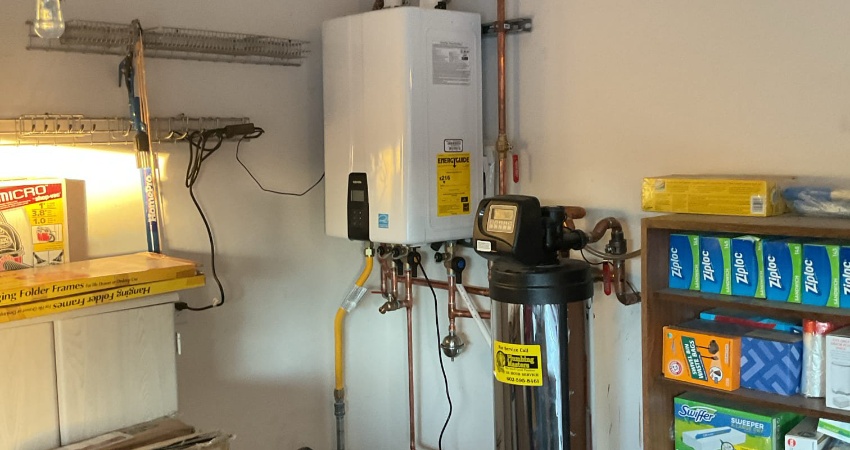
A whole-house reverse osmosis system isn’t always necessary for North Scottsdale homes connected to municipal water. Scottsdale Water already treats and monitors its drinking water to meet federal safety standards, and some homeowners who want additional purification can meet their needs with an under-sink reverse osmosis (RO) system at the kitchen sink.
However, there are situations where a whole-house RO system is your best option.
How Whole-House Reverse Osmosis Systems Work
Reverse osmosis uses pressure to push water through a semipermeable membrane that separates dissolved substances from treated water. According to the Centers for Disease Control and Prevention (CDC), RO membranes have pores approximately 0.0001 micron in size. They can reduce numerous dissolved substances, including certain metals, salts, and minerals, as well as microorganisms.
Unlike conventional carbon filtration, which primarily addresses certain chemicals and substances affecting taste and odor, RO can significantly reduce total dissolved solids (TDS).
A whole-house installation treats water at the home’s main supply line before distributing it to faucets, showers, appliances, and other fixtures. Because it must process considerably more water than a kitchen system, it typically requires additional equipment, including storage tanks, pumps, pretreatment filters, and controls.
Does North Scottsdale’s Water Need Whole-House RO?
Scottsdale’s municipal drinking water comes from a combination of surface water and groundwater sources. The city operates advanced treatment facilities and regularly monitors water quality throughout its distribution network.
Scottsdale Water performs hundreds of routine tests to ensure drinking water meets or exceeds Environmental Protection Agency standards. Its monitoring program includes testing for microbial contamination, metals, and other regulated substances.
Although North Scottsdale water contains naturally occurring minerals, hardness alone does not mean that comprehensive purification is necessary. Homes in DC Ranch, Grayhawk, Troon, and other North Scottsdale communities may benefit from water treatment, but whether it’s needed depends on what you’re trying to accomplish and the equipment you choose.
For example, homeowners primarily concerned about calcium and magnesium buildup may benefit more from water softening or conditioning than from a whole-house RO system. You may also be able to improve taste with a point-of-use system at your kitchen sink.
Whole-House RO System vs. Under-Sink RO: What’s the Difference?
Both systems use the same basic purification technology. The principal difference is how much water they treat and where that water is delivered.
| Feature | Whole-House RO | Under-Sink RO |
| Treatment location | Main water supply | Kitchen or designated faucet |
| Water treated | Most household water | Drinking and cooking water |
| Equipment | Larger, more complex | Compact |
| Installation | Extensive plumbing integration | Usually localized |
| Water consumption | Greater total treatment demand | Limited to point-of-use needs |
| Maintenance | Multiple components | Filters and membrane |
An under-sink system also avoids using highly purified water for activities that generally do not require it, such as flushing toilets, washing clothes, and outdoor cleaning.
When Does a Whole-House Reverse Osmosis System Make Sense?
Some properties have specific water chemistry concerns that conventional filtration, softening, or conditioning cannot adequately address. For example, a property supplied by a private well may have elevated dissolved solids or particular contaminants requiring specialized treatment.
A whole house RO system may be appropriate when water analysis identifies substances that require membrane treatment throughout the property.
Certain residential installations may also require very low-mineral water for specialized equipment or processes.
When Other Treatments Are Insufficient
If conventional filtration, water softening, and conditioning cannot achieve the required results, comprehensive RO may be worth evaluating.
Because RO removes minerals that influence water chemistry, whole-house systems may also need remineralization or other post-treatment to prevent corrosion and protect household plumbing.
However, if your primary concern is mineral scale, a properly selected softener or conditioner is generally more appropriate. If you want better-tasting drinking water, an under-sink RO system or suitable carbon filter may be sufficient.
A whole house reverse osmosis system also involves larger equipment, additional maintenance, and more complex plumbing requirements. For example, whole-house RO systems present a unique challenge for household plumbing. Because RO removes virtually all dissolved minerals, the resulting water becomes slightly acidic and aggressive. It’s often referred to as “hungry” water. Left untreated, this purified water actively leaches metals from copper pipes, brass fixtures, and water heater tanks throughout the home, leading to potential pinhole leaks and plumbing failure. To safely run a whole-house system, you’ll want to consider a dedicated remineralization unit or post-treatment pH neutralizer to protect your plumbing.
Choosing the Right Water Treatment for Your North Scottsdale Home
The best approach is to identify what you want to improve before selecting equipment.
George Brazil Plumbing & Electrical can help you evaluate your water treatment options and choose the right filtration, reverse osmosis, or water conditioning solution for your North Scottsdale home.
Schedule a free evaluation today. Our professional technicians can expertly assess your home and needs and recommend options that fit your budget.