
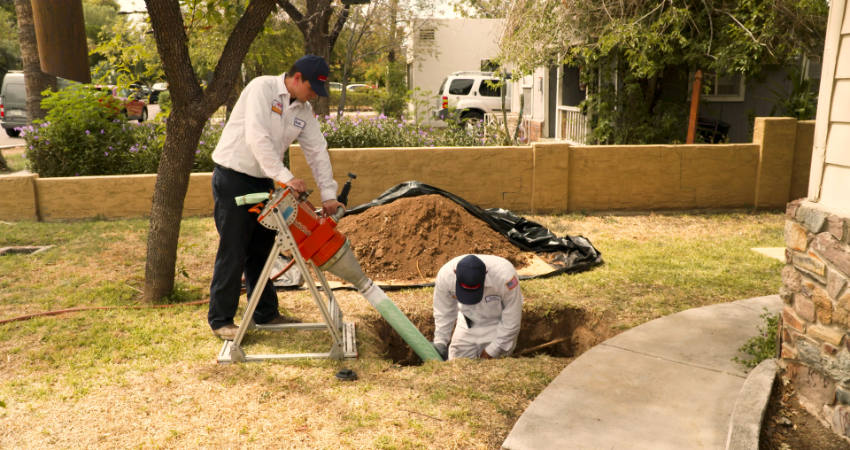
Sewer line repair in Phoenix can mean fixing one damaged section of pipe or replacing much of an aging system. Before your commit to sewer line repair, you need to fullly understand what’s going on underground. That includes the pipe material, type of damage, location, accessibility, and condition of the rest of the system.
That’s particularly important in established neighborhoods like many in north central Phoenix where clay and cast-iron sewer lines may have been underground for decades and nearing end-of-life. These materials don’t all fail in the same way, and symptoms such as recurring clogs or sewage backups don’t tell you whether you have a simple obstruction, cracked pipe, deteriorated cast iron, root intrusion, or structural failure.
Before deciding whether to repair or replace sewer line sections, the first step is finding out what failed and how extensive the problem really is.
Why Older North Central Phoenix Sewer Lines Need a Different Approach
Phoenix has a substantial stock of mid-20th-century housing. U.S. Census Bureau American Community Survey data shows a significant amount of Phoenix housing units built during the 1950s, 1960s, and 1970s. For homeowners in these older properties, that makes the age and condition of original underground plumbing particularly relevant when sewer problems begin appearing.
An older sewer line isn’t automatically bad. However, many original pipes have now been underground for several decades, and a sewer pipe repair or sewer line replacement may be needed.
Clay Sewer Lines
Clay pipe can remain functional for decades, but it is rigid. Soil movement and settling can contribute to cracks, shifted sections, and separated or offset joints. Those openings can allow surrounding soil or roots into the line. A joint that has shifted may also interfere with wastewater flow and collect debris.
The condition can vary considerably along the same sewer lateral. One section might remain intact while another has cracked or moved. That’s why discovering one clay-pipe defect doesn’t necessarily mean the entire line requires replacement.
Cast-Iron Sewer Lines
Cast iron has a different aging process. Corrosion can gradually affect the pipe’s interior and walls. Then, as the interior deteriorates, it may become rougher, making it easier for waste and debris to get stuck on the inside. Continued deterioration can weaken the pipe itself, eventually creating holes or even structural failure.
Clearing accumulated material may temporarily improve drainage, but it doesn’t restore metal that has deteriorated.
What Sewer Problems Should North Central Phoenix Homeowners Watch For?
These issues aren’t limited to one part of Phoenix. Homes in older neighborhoods like Orangewood, Windsor Square, Medlock Place, or Pierson Place may see problems. Neighborhoods built in the 50s, 60s, and 70s in areas such as Moon Valley, Royal Palm, Sunview Estates, Town & Country Paradise, and Roman Roads have sewer lines that may be 60 years old or older.
Regardless of where your home is, there are a few potential warning signs you should be on the lookout for that may indicate the need for sewer line repair in Phoenix, such as:
- Several drains slowing at the same time.
- Toilets gurgling when sinks or showers are used.
- Recurring main-line clogs.
- Sewage backing up through a tub or shower.
- Persistent sewer odors.
- Drainage problems returning soon after cleaning.
- Unexplained wet or unusually green areas outside.
These symptoms can indicate a sewer problem, but you’ll still need to figure out the cause and what type of sewer pipe repair is the best choice for your home or whether you need sewer line replacement.
Get A Sewer Camera Inspection
A sewer camera inspection can help detect and diagnose the problem. A technician feeds a flexible waterproof camera through the sewer system to examine the pipe’s interior. Depending on conditions, the inspection may reveal cracks, roots, separated or offset joints, corrosion, standing water, obstructions, or collapsed sections.
More importantly, the inspection can help answer four practical questions:
- Where is the problem?
- What appears to have caused it?
- How much pipe is affected?
- What condition is the surrounding pipe in?
Those answers will impact repair recommendations and the sewer line repair cost.
A localized defect surrounded by otherwise sound pipe presents a different situation from extensive deterioration along much of the sewer lateral. Likewise, a line that has collapsed or moved substantially may require a different approach than one that remains structurally intact.
When Does Sewer Pipe Repair Make Sense?
A localized sewer pipe repair may make sense when the damage is confined to a particular section and the surrounding pipe remains in serviceable condition. For example:
- One broken section
- A failed joint
- A localized tree root intrusion
- A defect that can be corrected without replacing a longer run of pipe
Age alone shouldn’t determine the decision. Two pipes installed around the same time can be in very different condition because of soil movement, pipe material, landscaping, previous work, and other factors.
When Does It Make More Sense to Replace a Sewer Line?
There are also situations where fixing individual defects may not address the larger problem.
Broader sewer line replacement may be considered when an inspection finds multiple failures, extensive cast iron deterioration, numerous damaged clay joints, significant structural problems, or several sections that have already required repairs. A collapse may also require the failed section to be removed and replaced.
| Inspection Finding | Possible Direction |
| One localized damaged section | Targeted repair may be considered |
| Several damaged clay joints | Broader repair or replacement may be needed |
| Extensive cast iron deterioration | Replacement may be considered |
| Structural collapse | Failed pipe must be replaced |
| Otherwise sound pipe with one defect | Localized repair may be sufficient |
Traditional Excavation: Phoenix Soil Can Affect the Project
Traditional excavation remains an important option for the type of sewer line repair Phoenix homeowners may need, particularly when crews require direct physical access to a damaged pipe.
Phoenix-area soil conditions will have to be taken into account. Caliche is common in Arizona soils, and it consists of soil particles cemented together by calcium carbonate. That can range from relatively loose material to highly consolidated, solid, rock-like layers several feet thick. Breaking through highly consolidated caliche can make digging substantially more difficult than excavating ordinary soil and add to the equipment and labor included in your sewer line repair cost.
Traditional access may be the best option when a pipe has collapsed, moved substantially out of alignment, lost its proper slope, or requires work that can only be performed by exposing it directly.
Surface conditions matter, too. Depending on the sewer route, excavation may disturb mature landscaping, concrete, pavers, patios, or driveways. Access and restoration then become part of the overall project, not simply what happens to the pipe underground.
Where Trenchless Sewer Line Repair Fits
Trenchless sewer line repair provides another potential option for certain pipe conditions. Broadly, trenchless methods are designed to repair or replace underground sewer piping while reducing the amount of open excavation required.
That can be particularly valuable on North Central Phoenix properties where conventional excavation would disturb mature trees, established landscaping, driveways, patios, or other hardscaping. Difficult digging conditions, including highly consolidated soil or caliche, can also make the amount of excavation an important consideration when comparing technically appropriate options.
However, trenchless does not automatically mean better or less expensive. The existing pipe must be appropriate for the particular method being considered. Significant collapse, major alignment problems, loss of proper slope, or other structural conditions can affect which options are feasible.
What Determines the Cost of Sewer Line Repair in Phoenix?
According to Angi, localized sewer repairs in Phoenix typically range from $1,000 to $5,000+, while complete replacements generally range from $3,000 to $15,000+. This includes a range of about $45 to $280 per linear foot depending on factors including method, pipe depth, and accessibility.
Those numbers show a big difference in sewer line repair costs and why accurate diagnosis is crucial to determine the best option. A qualified sewer line expert will have to take into account:
- Length of damaged pipe
- Depth of the sewer
- Pipe material
- Location and accessibility
- Type and extent of failure
- Soil and excavation conditions
- Repair method
- Surface removal and restoration
- Permits or inspections
Mature Trees Complicate North Central Phoenix Sewer Repairs
North Central Phoenix’s mature landscaping is connected to the Valley’s long history of irrigation. The Salt River Valley canal systems supported agriculture and development throughout our region, helping make extensive vegetation possible in an otherwise arid environment. Today, large established trees are part of the character of many North Central neighborhoods. The nutrients in wastewater are attractive to these roots.
A cracked clay pipe, separated joint, or other defect can provide an easy entry point for these roots. Once they burrow inside, they can grow over time, restricting wastewater flow and collecting debris. This may cause a break, damage pipe sections, or even lead to pipe collapse. Catching root intrusion early usually keeps the fix to a localized sewer line repair instead of a full replacement.
Who Is Responsible for the Sewer Lateral in Phoenix?
The City of Phoenix says property owners are responsible for cleaning and maintaining the sewer service line running from the house to its connection with the city sewer main in the street or alley.
That can make a difference when a problem is near the street or another public right-of-way. Before assuming responsibility for a particular repair, establish where the failure is located and whether it falls within an area for which the city provides repair.
The same goes for insurance. Insurance typically covers sudden, accidental internal water damage caused by a backup, but they typically exclude the actual repair or replacement of the exterior lateral pipe due to age, wear and tear, or tree root intrusion.
What Happens During a Sewer Line Repair Project?
Although every project differs, the basic process generally moves through five stages.
1. Diagnose the Problem
The plumber first determines what’s happening underground. Inspection findings help identify the type, location, and extent of damage.
2. Determine the Repair Scope
Next comes the decision between addressing a localized failure and performing broader work. If multiple sections are deteriorated, the recommendation may differ from one isolated defect.
3. Evaluate Access
Crews need to know where the sewer runs, how deep it is, what soil conditions they may encounter, and what’s above it. Landscaping, concrete, patios, driveways, and other improvements can affect how extensive the sewer line repair Phoenix homeowners need.
4. Complete the Repair
The affected section is repaired or replaced using a method appropriate for the pipe condition. If the findings indicate that crews need to replace sewer line sections more extensively, the project scope should identify how much pipe is involved.
5. Restore the Work Area
For projects involving excavation, disturbed areas are backfilled after the plumbing work is completed. The agreed scope should establish responsibility for restoring landscaping, concrete, pavers, or other surfaces.
Choosing a Phoenix Sewer Line Repair Contractor
When hiring someone for sewer line repair in Phoenix, start by verifying contractor information rather than relying solely on advertising or online reviews. The Arizona Registrar of Contractors provides an online contractor search portal you can use to check licensing information.
Beyond licensing, ask what evidence supports the proposed work. The contractor should be able to explain where the damage is, how much pipe is affected, and why the proposed scope addresses the condition found. You may want to view camera videos and soil sample results.
Get the scope in writing and determine what the estimate includes, such as excavation, replacement materials, backfilling, permits, inspections, cleanup, surface restoration, and warranty coverage. When comparing companies for sewer line repair in Phoenix projects, make sure you compare the same scope of work and quality of the contractor rather than simply choosing a lower bid.
Frequently Asked Questions — FAQs About Sewer Line Repair in Phoenix
How do I know if I need sewer line replacement or sewer line repair?
The decision should be based on the location and extent of damage and the condition of the surrounding pipe. A camera inspection can help determine whether the problem is localized or something more widespread. One damaged section may be repairable, while multiple failures or extensive deterioration may justify broader replacement.
Can a broken sewer line be repaired without replacing the entire pipe?
Yes, depending on the damage. If the problem is confined to one area and the rest of the sewer remains structurally sound, a targeted repair may be possible.
Is trenchless sewer line repair always better than excavation?
Trenchless methods can reduce surface disruption and may be especially worth evaluating where excavation would affect mature landscaping, hardscaping, or difficult soil. However, suitability depends on pipe condition, alignment, location, and type of failure.
How much does sewer line repair cost in Phoenix?
There are a lot of factors that go into determining the exact cost, which is why you’ll find wide ranges online. For example, Angi reports that localized repairs commonly range from $1,000 to $5,000+, with complete replacements costing $3,000 to $15,000 or more.
Contact George Brazil Plumbing & Electrical for sewer line repair service. Our highly-trained technicians can do a thorough evaluation, identify the damage, and present you with options and upfront pricing for sewer line repair or replacement.