
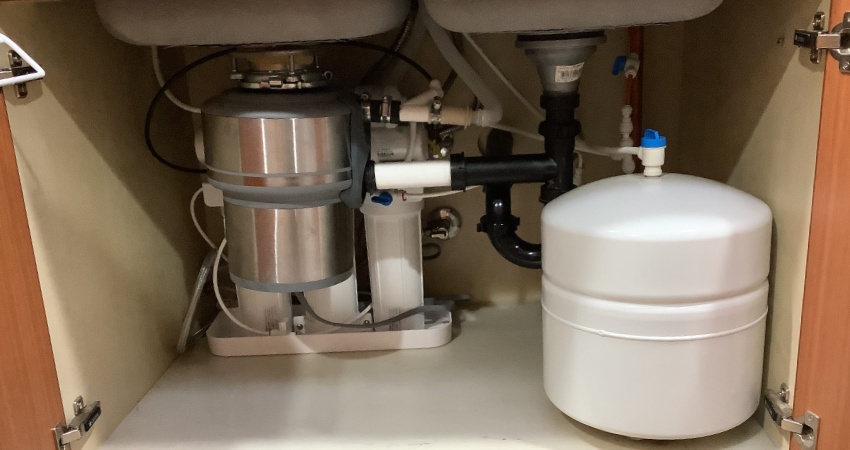
A reverse osmosis tank that loses pressure may have a low air charge, a damaged internal bladder, or a problem preventing it from filling properly. For Glendale homeowners experiencing slow water flow from their RO faucet, the solution may be as simple as servicing the existing system. However, an aging system with recurring problems may warrant replacement with a newer tankless model.
In Glendale neighborhoods such as Arrowhead Ranch and Hillcrest Ranch, where hard water makes filtration an important consideration, understanding the difference between tank-based and tankless reverse osmosis can help homeowners choose the right solution.
Why Is Your Reverse Osmosis Tank Losing Pressure?
Traditional reverse osmosis tank filters water through a semipermeable membrane, removing dissolved minerals and other contaminants. The treated water collects in a pressurized storage tank until someone opens the dedicated drinking water faucet.
Inside the tank, an air-filled chamber separated from the water by a flexible bladder provides pressure to push filtered water toward the faucet. When something interferes with this process, homeowners may notice a weak stream, inconsistent flow, or water that quickly slows to a trickle.
Common Causes of Low RO Water Pressure
Several issues can cause these symptoms:
- Low tank air pressure: Over time, the tank can lose some of its air charge. Without adequate pressure, it cannot effectively deliver stored water to the faucet.
- Failed tank bladder: A damaged internal bladder can prevent the tank from maintaining the pressure needed to dispense water.
- Clogged filters: Sediment and carbon filters accumulate contaminants over time, restricting water flow through the system.
- Fouled RO membrane: Mineral scaling and accumulated contaminants can reduce water production, particularly when the system processes hard water.
- Low incoming water pressure: Insufficient supply pressure may prevent the RO membrane from producing water efficiently.
- Blocked tubing or faucet: Restrictions in the delivery line or drinking water faucet can reduce flow even when the storage tank is operating correctly.
One important distinction is whether the tank has lost its ability to deliver water or the filtration system cannot produce enough water to refill it. Both problems can cause similar symptoms but require different repairs.
Tank vs. Tankless Reverse Osmosis System: What’s the Difference?
Traditional tank-based RO systems produce filtered water relatively slowly and store it until needed. This allows you to draw several glasses of drinking water without waiting for the membrane to process each gallon.
A tankless reverse osmosis system eliminates the storage reservoir. Instead, it filters water as needed, typically using an electrically powered booster pump and a higher-capacity membrane to deliver water directly to the faucet. Both approaches have advantages and limitations.
| Feature | Tank-Based RO | Tankless RO |
| Water delivery | Stored, pressurized water | Filtered on demand |
| Under-sink space | Requires storage tank | Generally more compact |
| Water flow | Depends on tank pressure and available stored water | Depends on membrane capacity and pump design |
| Maintenance | Filters, membrane, and tank | Filters, membrane, and sometimes pump |
| Electricity | Often unnecessary | Typically required |
| Initial investment | Generally lower | Generally higher |
The biggest practical advantage of tankless RO is eliminating the storage tank and its associated pressure problems. Without a tank, you do not have to worry about a failed bladder or declining tank air pressure. However, tankless reverse osmosis systems have their own potential failure points. Pumps, electronic components, and flow sensors may eventually require service. A tankless system also needs sufficient production capacity to meet household demand.
Neither option is automatically better for water quality. Filtration performance depends on membrane specifications, system design, maintenance, and appropriate contaminant-reduction certifications rather than whether the unit includes a tank.
Should You Repair Your RO Tank or Replace the System?
A weak RO faucet does not necessarily mean the entire filtration system needs replacement. The best decision depends on the cause of the problem, the equipment’s age, and its overall condition.
Repair may be the most practical choice when:
- The tank has lost some air pressure, but the bladder remains intact.
- Sediment or carbon filters are overdue for replacement.
- The RO membrane needs cleaning or replacement according to manufacturer recommendations.
- A clogged faucet or restricted water line is causing poor flow.
- The system is otherwise functioning properly.
The water filtration experts at George Brazil can check your tank’s air charge with the water side fully depressurized, inspect the system, and determine whether a straightforward repair will restore normal operation.
When Upgrading to Tankless RO Makes Sense
Replacement may be worth considering when:
- The storage tank has failed, and other components are approaching the end of their service life.
- The system requires frequent repairs.
- Under-sink cabinet space is limited.
- The household regularly exhausts its stored drinking water.
- Homeowners want a higher-capacity filtration system with fewer storage-related components.
Get Help With RO Water Pressure Problems in Glendale
Whether you have a traditional storage-tank RO system or are considering an upgrade, identifying the underlying problem is the first step. A professional inspection can determine whether weak flow results from tank pressure, restricted filters, membrane performance, or another issue. George Brazil primarily stocks and installs tank-style RO systems. Tankless units are available on request through our suppliers.
For homeowners in Arrowhead Ranch, Hillcrest Ranch, and throughout Glendale, George Brazil Plumbing & Electrical can help evaluate existing filtration equipment and recommend appropriate repairs or replacement options. Contact George Brazil for professional reverse osmosis repair for your Glendale home.