
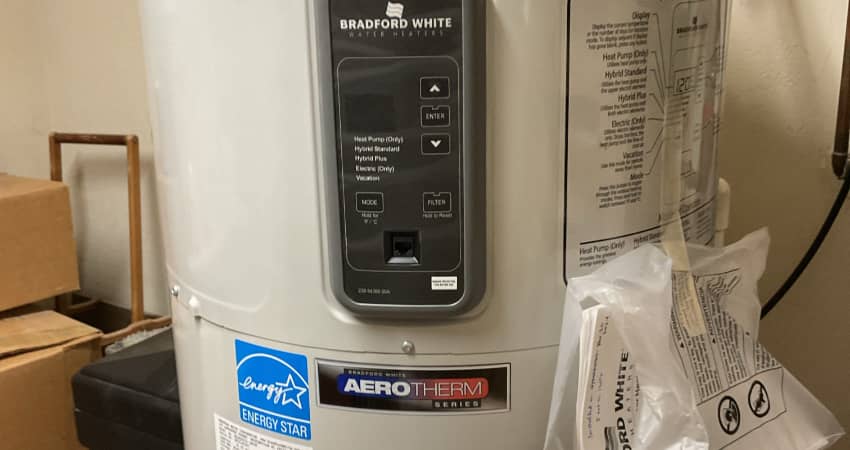
The most common signs your water heater needs to be replaced include an aging tank, declining hot-water performance, leaks, unusual noises, and repeated repairs. Some problems can be fixed without replacing the entire unit, but when several of these issues appear together, especially on an older electric water heater, replacement may be the more practical option.
For homeowners in Ahwatukee and throughout the East Valley, catching these warning signs early can help reduce the risk of suddenly losing hot water or dealing with a leaking tank.
1. Your Water Heater Is More Than 10 Years Old
Age is one of the clearest reasons to start thinking about replacement. ENERGY STAR recommends that homeowners begin planning for a new water heater once the existing unit is more than 10 years old rather than waiting until it fails completely. That does not mean every 10-year-old unit needs to be replaced immediately, but it is a good point to start watching performance more closely and evaluating your options.
An older unit that has also begun leaking, making noise, or struggling to produce enough hot water deserves closer attention.
2. Your Electric Water Heater Is Not Heating Properly
If your electric water heater not heating is the main issue, call for water heater service.
Electric water heaters rely on heating elements and thermostats that can fail over time. A bad heating element, faulty thermostat, tripped breaker, or wiring problem may be repairable. Common symptoms include no hot water, water that never gets fully hot, or a tank that runs out of hot water much faster than it used to.
The age of the equipment matters here. A failed heating element on a relatively new tank may be a straightforward repair. The same failure on an older unit with a history of problems may be a sign that replacement deserves consideration. A professional diagnosis can help separate a repairable component failure from a broader problem with the water heater itself.
3. You See Water Around the Tank
Water around the base of the heater should never be ignored. However, a leak from a plumbing connection, pressure-relief valve, or another replaceable component may be repairable. A leak coming directly from the tank is more serious and generally means the tank has deteriorated internally.
As steel tanks age, corrosion can eventually weaken the metal and allow water to escape. Once the tank itself starts leaking, there is no practical repair that can restore its structural integrity…except replacement.
Even a small amount of unexplained moisture around an older unit is worth investigating.
4. The Water Heater Is Making New or Unusual Noises
Popping, rumbling, crackling, or banging sounds can indicate changes inside the tank. Over time, minerals and sediment can collect at the bottom of a conventional electric water heater. When the heating elements warm the water, water and mineral deposits can create unusual sounds.
Mineral buildup can also affect efficiency and hot-water performance. This is particularly relevant in the Phoenix area, where hard water can contribute to scale and sediment accumulation.
Noise alone does not necessarily mean the water heater must be replaced. However, a noisy older tank that is also delivering less hot water or showing other signs of deterioration may be approaching the end of its useful life.
5. Repairs Are Becoming More Frequent
An occasional repair is normal for many appliances. Repeated repairs are different.
If you find your electric water heater not heating more than once if you have already replaced heating elements, thermostats, valves, or other components, and your water heater continues to have problems, it may be time to look at the system as a whole.
Repeated failures can be especially important when the tank is already close to or beyond the typical replacement-planning age. Continuing to repair individual parts does not address corrosion or deterioration of the tank itself.
The signs your water heater needs to be replaced are often most convincing when age, poor performance, and repair history all point in the same direction.
Repair or Replace? Look at the Whole Picture
There is no single rule that determines whether an electric water heater should be repaired or replaced. You need to consider the age of the tank, the source of the problem, its overall condition, how frequently repairs are needed, and whether the heater still meets your household’s hot-water needs.
If an electric water heater not heating is the only symptom, diagnosis should come first. If the tank is leaking, more than a decade old, and experiencing repeated problems, replacement becomes much more likely. Having the unit evaluated before a complete failure can also give you time to compare replacement options instead of making a rushed decision after the hot water stops.
Call George Brazil Plumbing & Electrical to inspect your Ahwatukee or Phoenix-area electric water heater and help you determine whether repair or replacement makes the most sense.