
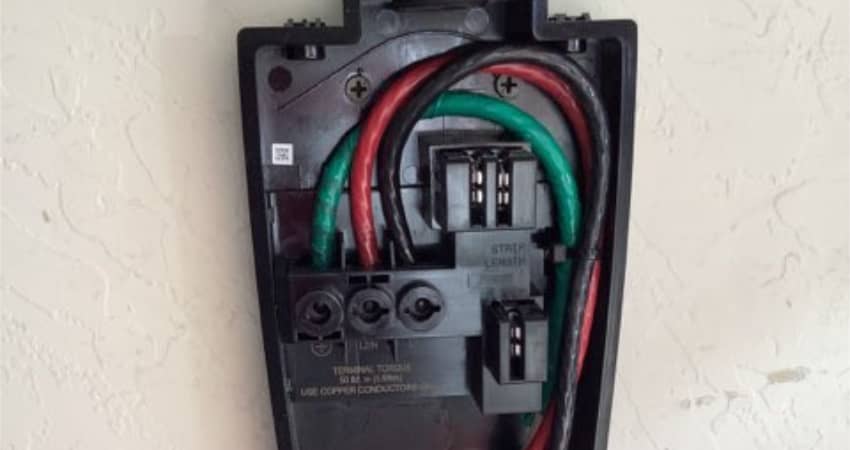
If you live in Scottsdale and only drive a short distance, Level 1 charging may be sufficient if you can leave your vehicle plugged in for long periods. However, Level 2 charging is generally the more practical choice for battery-electric vehicles, multi-EV households, and drivers who want to recharge overnight. The U.S. Department of Transportation estimates that charging a battery-electric vehicle to 80% can take more than 40 to 50 hours with Level 1 equipment, compared with approximately four to 10 hours using Level 2.
Level 1 vs. Level 2 EV Charging
Level 1 and Level 2 chargers both use alternating-current electricity, but they operate at different voltages and charging speeds. Here’s how they compare.
Feature | Level 1 Charging | Level 2 Charging |
|---|---|---|
Electrical service | Standard 120-volt outlet | 240-volt residential circuit |
Typical power output | About 1 kilowatt | About 7 to 19 kilowatts |
Estimated BEV charging time | 40 to 50 hours from empty | Four to 10 hours from empty |
Range added per hour | Approximately 2 to 5 miles | Approximately 10 to 20 miles |
Installation | Often plugs into an existing outlet | Usually requires a dedicated circuit |
Best suited for | Low-mileage drivers and plug-in hybrids | Battery EVs, longer commutes, and frequent driving |
Upfront cost | Usually lower | Higher due to equipment and electrical work |
convenience | Limited by slow charging | Usually supports overnight charging |
Actual performance varies based on the vehicle, charger, battery capacity, temperature, and the amount of power the vehicle can accept.
How Level 1 Charging Works
Level 1 charging uses a standard 120-volt household receptacle. Many EVs include a portable charging cable that can plug into this type of outlet, so homeowners may be able to start charging without purchasing a wall-mounted station.
This simplicity is Level 1 charging’s primary advantage. It may work well for someone who drives only 10 or 20 miles per day and consistently parks at home overnight. It can also be practical for plug-in hybrids because their smaller batteries generally require less time to recharge.
The drawback is speed. A Scottsdale homeowner who drives 50 miles in a day could need 10 hours or more just to replace that energy.
Level 1 is also frustrating after a long trip, during a week of heavy driving, or when more than one EV depends on the same charging location. It may also be unsuitable if the available outlet is old, damaged, shared with other appliances, or located where an extension cord would be required.
How Level 2 Charging Works
Residential Level 2 charging uses a 240-volt electrical circuit and delivers considerably more power than a standard wall outlet, typically restoring a substantial portion of an EV battery overnight.
Most installations require a new dedicated circuit connected to the home’s electrical panel. The charger can be hardwired directly into the electrical system or plugged into a compatible 240-volt receptacle, depending on the equipment and local code requirements.
A qualified Level 2 EV charger installer can inspect your panel, calculate the existing electrical load, confirm available breaker space, and determine the correct circuit and wiring size. The charger’s output should also be matched to the vehicle’s onboard charging capacity. Installing a higher-powered charger does not necessarily make the vehicle charge faster if the car cannot accept the additional power.
Who Installs Level 2 EV Chargers?
If you’re wondering who installs Level 2 EV chargers, you need a qualified electrician. Because the work involves a high-powered, continuous electrical load, it should be completed by an electrician familiar with EV charging equipment and Scottsdale electrical codes.
Some homes have sufficient electrical capacity but lack open breaker spaces. Others may benefit from a subpanel or load-management device instead of a complete service upgrade. An electrical evaluation by a Level 2 EV charger installer can identify the safest and most cost-effective approach.
With George Brazil, you get transparent, upfront pricing that includes all of the work needed, including permits. So, you’ll know exactly what you’ll pay before the work begins. The highly-trained technicians at George Brazil Plumbing & Electrical are qualified Level 2 EV charger installers with years of experience to provide you with an affordable, safe, and long-term charging solution.
George Brazil Plumbing & Electrical can evaluate your panel, charging location, and driving needs. Contact us to schedule an assessment with a Level 2 EV charger installer and determine the right EV charging solution for your home.