
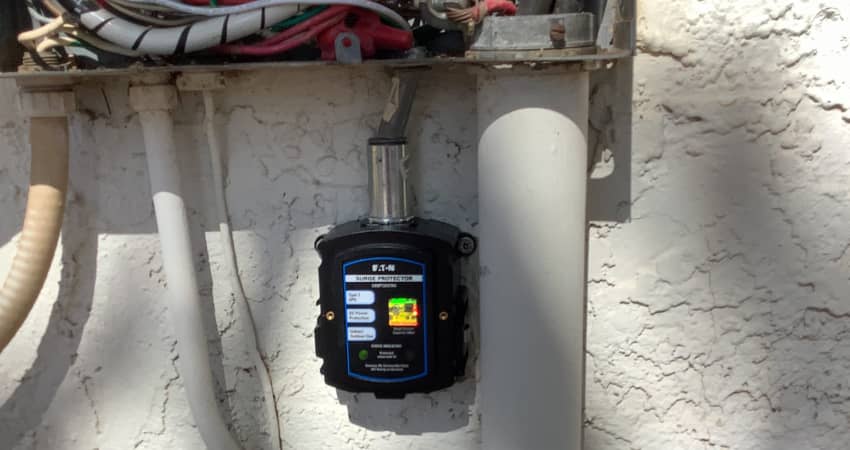
Scottsdale’s housing stock concentrates more dollars per square foot of vulnerable electronics than almost anywhere in the Valley: luxury smart-home systems, dual HVAC compressors, EV chargers, pool equipment, designer LED, and solar inverters — not to mention all of your other appliances. And the weather here can cause considerable damage. Arizona experienced more than $34 billion dollars in weather and climate disasters over the past three decades, averaging about $1.8 billion every year.
A $30 power strip from a big box store isn’t going to protect your home.
Grid fluctuations and monsoon lightning create thousands of micro-surges per year that point-of-use strips can’t stop because they’re downstream of the damage. You need an electrician-installed Type 2 panel-mounted protection with monsoon-rated grounding diagnostics. In Scottsdale, George Brazil is the only electrical company that can provide that for you.
What Is a Surge Protector?
If you’re wondering what is a surge protector, the short version is this: a surge protector is a device designed to help protect equipment from sudden voltage spikes. When excess voltage enters the electrical system, the surge protector attempts to redirect that energy before it reaches anything you have connected to it. Without surge protection, these power spikes can damage equipment.
You probably have a surge protector plugged into an outlet somewhere in your home, maybe for a computer or TV, but that’s only protecting specific devices. There’s also a big difference between a surge protector and a power strip. They may look the same, but power strips don’t have any built-in surge protection. They’re just giving you more outlets.
What Is a Surge Protector for Your Whole House?
A whole home surge protector takes the same basic concept, but covers your entire electrical system. Instead of protecting only the devices plugged into a single strip, it helps protect equipment throughout your home’s electrical system. When excess power comes into your home, it intercepts the voltage spikes before it gets to your AC system or other components.
How Whole Home Surge Protection Works
A whole house surge protector consistently monitors your incoming voltage. When it detects excess energy that might be unsafe, it redirects it away from your electrical system. It happens in microseconds, so you’ll most likely never even notice it happening. In the meantime, your electricity flows normally so everything will just keep working.
Whole House Surge Protectors Cover All of Your Electrical Devices
Think of all the things you have around your home that use electricity, and the cost of repairing or replacing them if a power spike fries the components. For example:
| System | Examples |
| HVAC Equipment | Air conditioners, heat pumps |
| Electronics | Televisions, computers, routers |
| Appliances | Refrigerators, ovens, dishwashers |
| Smart Home Systems | Security cameras, automation hubs |
| Specialty Equipment | EV chargers, pool controls, solar equipment |
Any one of these items that gets damaged will likely cost more to replace than the cost of a home surge protector.
Scottsdale Homes Face Unique Surge Risks
Every home can experience power surges, but we see some unique challenges in Scottsdale.
Monsoon Storms
Summer monsoons bring lightning, wind, dust storms, and… power outages. Even if lightning doesn’t directly hit your home, even a nearby strike can produce voltage spikes that travel through utility lines and into your home. And, if your power goes out, fluctuations are common when the power comes back on. Over time, this can damage electronics.
Extreme Summer Power Demand
Here in the Valley, we run our AC units continuously during the high heat days. This puts a big demand on the electrical grid. Utility companies like APS and SRP have to continuously balance this load. However, load balancing and grid switching can create voltage fluctuations. You may never notice the difference, but it can put extra stress on your electrical equipment.
Larger, More Complex Electrical Systems
Modern homes in our area have electrical components that are much more common than a decade ago. Think home offices, security systems, EV chargers, multiple HVAC systems, battery backups, solar panels, pools, spas, etc. Everything connected to your electrical system is a potential point of vulnerability.
Some experts estimate that the majority of surges affecting a home actually originate inside the home itself.
Whole Home Surge Protectors for Large and Small Power Surges
A lightning strike is dramatic, but many power surges are small. They don’t trip breakers. The lights don’t flicker, and there’s no visible damage. But, they add to the stress on your electronics and take a toll over time.
Typically, the damage goes unnoticed. Everything seems to work fine after power is restored, but underneath it all, your equipment is slowly wearing out. Weeks or months later, when the component fails, you might think it was simply normal wear and tear. In reality, repeated electrical stress may have shortened the equipment’s lifespan.
This is particularly important for expensive equipment such as HVAC systems, smart-home technology, pool automation systems, and EV charging equipment. A single repair bill can easily exceed the cost of installing whole home surge protectors. And, if you have to replace a system altogether, the expense can be significant. Replacing an HAV system can run from $8,000 to $15,000 or more.
How To Choose the Right Whole Home Surge Protectors
Once you decide you want whole home surge protection, the next challenge is understanding which products are actually worth considering.
Walk through a home improvement store, and you’ll find dozens of devices claiming to offer protection. However, do you know which specs really matter? Here’s what you need to know.
Home Surge Protector Current Ratings
One of the most important specifications is the surge current rating. This measures how much energy a device is designed to handle. Typically, higher-rated devices have greater capacity to withstand large surge events and repeated smaller surges.
However, it’s not just the highest-rated device that’s right for your home; it’s the right-sized unit to protect your equipment. This is another reason you want an experienced, qualified electrician to evaluate your electrical system and recommend the best solution for your home.
Look for UL Listed Devices
When a device says it’s UL listed, it means it has undergone a series of tests to ensure it works properly. While certification doesn’t guarantee performance, it does give you peace of mind that it meets current safety standards. indicates that a product has been tested against recognized safety standards.
Status Indicators and Monitoring Features
A whole house surge protector only protectors your home if its working right. Many systems have indicator lights or even Wi-Fi monitoring that lets you confirm it’s active. If the device experiences a major surge event or the equipment fails, the indicator can alert you that a replacement might be needed.
Warranty Coverage
Manufacturers provide warranties on the whole house surge protector and may also include equipment protection for devices wired into your electrical system. You’ll want to check coverage though, as amounts and duration can vary. For example, some manufacturers offer a three-year warranty while others are for the lifetime of the device. Equipment coverage amounts can vary between $10,000 and $75,000.
There are also limitations:
- Manufacturers require that whole house surge protectors are installed by a qualified electrician following all National Electrical Code (NEC) standards.
- In most cases, any claims are secondary to your homeowner’s insurance.
- Direct lighting strikes are usually excluded.
Installing Surge Protectors for Your Home: What You Should Know
Most whole home surge protectorsare installed directly at the electrical panel to intercept voltage spikes as close as possible to where electricity enters the home. Because every electrical circuit ultimately connects through the panel, panel-mounted protection provides coverage throughout the house.
How well a surge protector for homes works depends heavily on how they are installed. The wrong type of electrical panel, length of wiring, and connectivity can impact performance (and warranty claims). Professional installation is always recommended.
When you are considering whole-home surge protection, there are a few basic questions you should ask your electrician.
| Question | Why Ask It |
| Where exactly will the device be mounted? | To find out if it will be installed inside the main breaker panel, flush-mounted next to it, or outside near the meter (which requires an outdoor-rated NEMA enclosure). |
| Do I have enough physical space and an open slot in my panel? | Most standard whole-home protectors require a dedicated two-pole (240V) breaker to function properly. If the panel is completely full, the electrician will need to discuss options like tandem breakers or a subpanel. |
| How long will the connecting wires (leads) be? | Lead length is critical for performance. Every inch of wire adds impedance; wires should be as short, straight, and free of sharp bends as possible to ensure the surge is intercepted instantly. |
| Does my electrical system have a verified, solid ground? | A surge protector doesn’t absorb the spike—it dumps the excess voltage into the earth. If the home’s grounding rod or connection is old, loose, or corroded, the protector won’t work effectively. |
| What is the Voltage Protection Rating (VPR)? | While the surge rating (kA) tells you how big of a hit it can take, the VPR (or clamping voltage) tells you the maximum voltage the device will let “bleed” through to your appliances before it triggers. Lower is better. |
| Will this protect my cable, internet, or phone lines too? | Surges frequently enter homes through coaxial cables or telephone lines rather than the electrical main. Homeowners should know if they need a combination unit or separate modules for data lines. |
How Much Does a Whole Home Surge Protector Cost?
Adding whole home surge protectors is surprisingly less expensive than you might think. The device itself can cost between $100 and $300. With installation, you’re likely looking at $300 to $800, depending on your home’s electrical system.
Most installations are relatively straightforward when the electrical panel is in good condition, but there are a few things that can lead to higher prices, such as:
- A maxed-out electrical panel: If your panel is full, your electrician will have to rearrange existing circuits, install a subpanel, or replace your panel.
- Subpanels in your home or garage: Depending on the configuration, you may need a separate device at both locations.
- Faulty grounding: Surge protectors for homes divert excess energy into the ground. If your grounding rod doesn’t meet code, or it’s corroded, you’ll need to replace it.
- Outdoor enclosures: If your electrical panel is located outside, you’ll need a weatherproof, outdoor-rated NEMA enclosure.
It’s a mistake, though, to make your decision solely based on the price of a home surge protector install. Think about the thousands of dollars it will cost to replace your HVAC system, kitchen appliance, computers, and other components. By comparison, a whole house surge protector is a small investment.
Electricians Recommend Layered Protection
A whole home surge protector provides broad protection at your electrical panel. However, some homeowners choose to add additional surge protection at individual outlets for particularly sensitive electronics.
This layered approach creates multiple levels of protection throughout the home. Plug-in surge protection still makes sense for many components, including:
- Computers
- Home office equipment
- Gaming systems
- Entertainment centers
- Networking equipment
Signs It May Be Time to Upgrade Your Surge Protection
Like other electrical devices, surge protection systems don’t last forever. You may want to have your electrical system evaluated if:
- Your surge protector is more than three years old.
- You recently upgraded your electrical panel.
- You installed an EV charger, solar equipment, or a new HVAC system.
- You expanded your smart-home system.
- Your neighborhood experiences frequent outages or power fluctuations.
A professional evaluation can help determine whether existing protection remains adequate.
FAQs — Frequently Asked Questions About Whole Home Surge Protection
What is a whole house surge protector?
A whole-house surge protector is a device installed at the electrical panel that helps protect appliances, electronics, HVAC equipment, and other systems from damaging voltage spikes.
Do whole house surge protectors really work?
Yes. While no device can guarantee protection from every possible electrical event, properly installed surge protection can significantly reduce exposure to damaging voltage spikes.
Can a surge protector protect my air conditioner?
Yes. One of the primary benefits of whole-home protection is helping protect hardwired systems such as air conditioners, heat pumps, and other HVAC equipment.
Is whole home surge protection required by code?
Under the revised NEC, whole-home surge protection is now required for homes that are undergoing panel replacements or electrical service upgrades. Most older homes, however, do not have surge protection built in.
If you’re considering whole home surge protector, George Brazil can evaluate your electrical system, explain your options, and help you select the right solution designed for your Scottsdale home. Call today for service.