
If you’ve lived in Scottsdale for more than a year, you’ve probably seen headlines like these:
- Thousands lose power amid monsoon storms in Phoenix
- Severe monsoon storms take down more than 400 power poles, affecting 32,000 customers
- More than 40,000 people in the Phoenix area lose power
It’s bad enough when the lights go out, but it can also be serious damage when the power goes back on. There are often fluctuations in the electricity supply, which can zap your appliances. Even lightning that flashes nearby can jolt the energy flowing through the power lines into your home.
Electronics plugged into power strips have no protection against this. Plug-in surge protectors offer only limited protection for connected appliances. Yet, many appliances aren’t plugged into sockets. For example, your home’s air conditioning system is directly wired to your electrical panel. Without whole-house surge protection, you’re at risk from these power fluctuations.
If you’ve ever wondered how do whole house surge protectors work, the answer is actually simple. They monitor your electrical system for voltage variations. When dangerous spikes occur, whole-house surge protectors prevent excess voltage from reaching your electrical system. It doesn’t interfere with your lights or electric power, but it shields your system from these power spikes.
When considering the safety of your home, you might wonder, do whole house surge protectors work, and how exactly do they prevent power surges? We’ll explain.
Scottsdale Power Surges
Arizona Public Service (APS) and Salt River Project (SRP) both serve portions of Scottsdale and typically resolve routine outages within a two- to four-hour period. But even during routine service, voltage can vary, especially when the system is strained during the hot summer months when everybody’s running the AC full-time. You can also experience power surges when utility companies reroute power to balance electrical loads or perform maintenance, and when your large appliances cycle on and off.
Sometimes, the damage happens immediately. In most cases, however, it’s a cumulative effect. Repeated small surges gradually wear down components in your electronics, shortening their useful life.
How Do Whole House Surge Protectors Work?
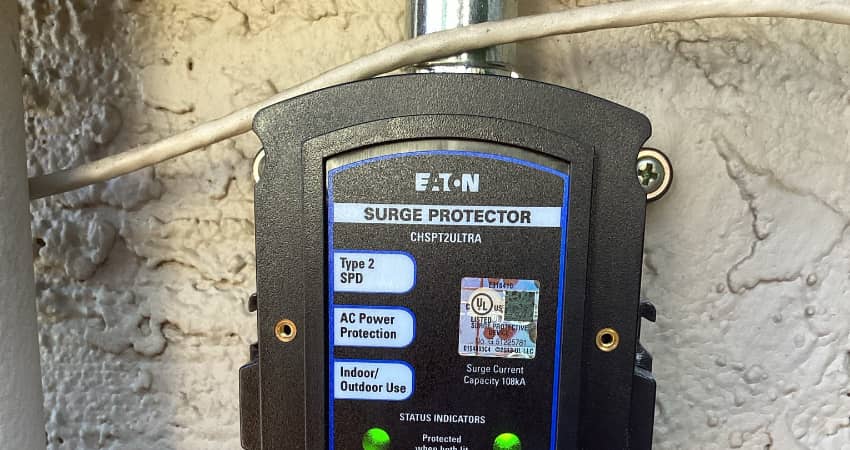
Whole-house surge protectors are installed directly at your home’s electrical panel, where electricity enters your home, acting as a gatekeeper. If the power is consistent, things flow normally. But the moment it detects voltage that exceeds safe limits, it responds.
When this excessive electrical energy enters your system, the surge protector creates a safe pathway, redirecting the excess voltage away from your home’s wiring and equipment. So, instead of allowing that energy to reach your air conditioner, television, refrigerator, or computer, the device safely routes it elsewhere before it can cause damage.
Electrical surges happen in fractions of a second, which is why high-quality whole-house surge protectors react in microseconds. Speed is critical to stop the energy from flowing into your system, so by the time you notice a fluctuation, the surge event has already happened.
Cheap Surge Protectors Often Fall Short
While all surge protectors perform the same basic function, there can be significant differences in how they perform to protect your home. Answering the question, do whole house surge protectors work, depends on the quality of the device itself:
- Smaller internal components may limit the amount of surge energy the device can safely handle.
- Lower surge-current ratings often mean reduced protection during larger electrical events.
- Some inexpensive devices wear out much faster when exposed to repeated surges.
- Budget models may not provide meaningful protection against sustained voltage fluctuations.
- Some devices lack status indicators, making it difficult to know whether protection is still active or the device is working.
What Features Should Homeowners Look For?
When you are considering your options for adding whole home surge protection, there are a couple of key factors to keep in mind. Look for these features.
| Feature | Why It Matters |
| High Surge Current Rating | Helps handle larger surge events |
| UL Listing | Has passed rigorous safety testing |
| Status Indicator Lights | Confirms the device is still functioning properly |
| Equipment Warranty | Provides additional protection for homeowners |
| Professional Installation | Ensures proper operation and performance |
A qualified electrician can help determine which protection level makes sense based on your home’s electrical system and the equipment you’re trying to protect.
Staying Ahead of the Storm and Power Surges
Electrical surges happen far more often than you probably realize. While lightning gets the attention, utility switching events, power restoration, and everyday electrical activity can also create damaging voltage spikes.
If you’re considering surge protection for your Scottsdale home, George Brazil can evaluate your electrical system and help you choose the right level of protection for your appliances, electronics, and HVAC equipment.
Contact George Brazil Plumbing & Electrical today to schedule a visit in Scottsdale.