
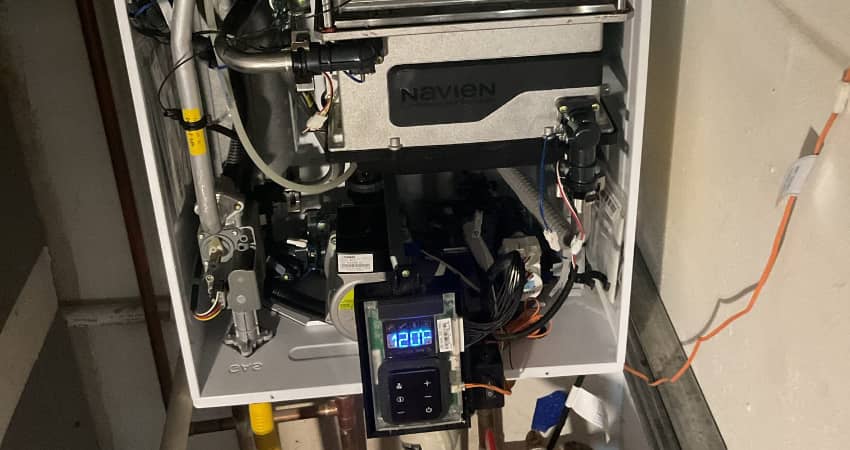
Do tankless water heaters work with hard water? Yes, and that’s good news because the water in Scottsdale is considered “very hard.” Neighborhoods such as McDowell Mountain Ranch, Desert Mountain, or DC Ranch/Silverleaf all have hard water, and it can take a toll on your water heater.
How Hard Is Scottsdale’s Water?
In technical terms, the municipal water hardness ranges from approximately 16 to 25 grains per gallon, depending on where you live in the city. That means homeowners in different parts of Scottsdale may experience somewhat different mineral levels, but the entire range represents relatively hard water.
The Water Quality Association classifies water above about 10.5 grains per gallon as very hard. At Scottsdale’s upper range, hardness levels can be more than twice that benchmark.
Calcium and magnesium are the primary minerals responsible for hardness, and they can form scale deposits when water is heated. Hard water is not generally a health concern at these levels, but it can create plumbing and appliance problems. For a tankless water heater, one of the biggest concerns is what happens inside the heat exchanger.
How Hard Water Affects Tankless Systems
A tankless water heater heats water as it passes through the unit rather than storing a large supply in a tank. That requires water to move through relatively narrow internal passages while the heat exchanger rapidly raises its temperature.
As hard water is heated, dissolved minerals can leave deposits behind on those internal surfaces. Over time, scale can create a coating on the heat exchanger. That layer makes it harder for heat to transfer efficiently from the burner or heating element to the water. Mineral deposits can also begin to restrict internal water passages.
The problem typically develops gradually. A unit may continue producing hot water even as scale is building, which means homeowners may not realize maintenance is needed until performance begins to change.
What Scale Buildup Can Do to Performance
Scale accumulation can affect a tankless system in several ways. You may notice that hot water takes longer to reach the desired temperature or that temperatures fluctuate more than they once did. Water flow may also decrease if mineral deposits begin narrowing internal passages.
A heat exchanger with scale requires the system to work harder to deliver the same amount of heat. In more severe cases, the unit may produce fault codes or shut itself down to protect internal components.
Do You Need a Water Softener for a Tankless Water Heater?
Installing a water softener for tankless water heater protection can help reduce the amount of calcium and magnesium entering the unit, but it’s not mandatory.
Traditional whole-home water softeners use ion exchange to remove hardness minerals before the water reaches plumbing fixtures and appliances. Reducing those minerals can slow scale formation inside the tankless heat exchanger and elsewhere in the plumbing system.
Maintenance Becomes More Important With Hard Water
Even with water treatment, tankless systems are not maintenance-free.
Descaling involves circulating a cleaning solution through the heat exchanger to dissolve mineral deposits. How often this should be done varies based on actual water hardness, household consumption, whether water treatment is installed, and the manufacturer’s instructions.
Because Scottsdale’s water falls into the very-hard range, some homeowners may need descaling more frequently than someone living in an area with soft water. Following the manufacturer’s recommended service schedule and adjusting it for local conditions can help prevent heavy deposits from accumulating. Typically, you need to descale at least once or twice per year.
Can You Use Tankless Successfully in McDowell Mountain Ranch?
For McDowell Mountain Ranch homeowners asking, do tankless water heaters work with hard water, the answer is yes. A properly installed and maintained tankless system can still provide reliable hot water in a hard-water environment.
Whether you need a water softener for tankless water heater protection depends on your specific system, water conditions, and maintenance strategy, but addressing hardness upfront can help protect performance over the life of the equipment.
George Brazil Plumbing & Electrical can evaluate your Scottsdale home’s water conditions and options to help you choose the right approach to hard-water protection and maintenance. Schedule a call today.