
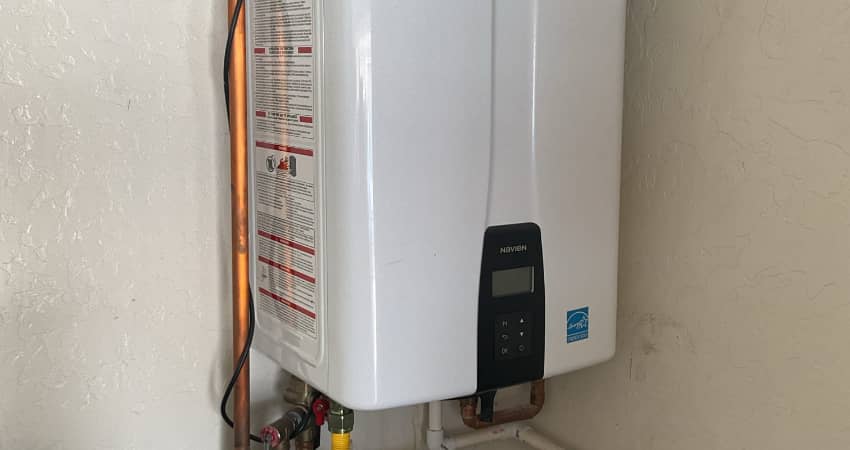
For many homeowners considering a tankless water heater in Scottsdale, making the switch can be worthwhile. Tankless systems can provide continuous hot water when properly sized, eliminate the standby heat loss associated with storage tanks, take up less space, and potentially last longer.
However, a tankless water heater installation can be more involved than replacing one storage tank with another. Gas capacity, electrical service, venting, household hot-water demand, Scottsdale’s hard water, and your home’s existing plumbing all affect the decision. For homeowners in neighborhoods such as McDowell Mountain Ranch, Desert Mountain, or DC Ranch, evaluating those factors before buying equipment can help avoid surprises during installation.
How Does a Tankless Water Heater Work?
A conventional water heater fills a tank with water, heats it, and keeps that supply hot until someone needs it. The burner or heating elements cycle periodically to replace heat that escapes through the tank.
Tankless systems eliminate the storage tank. When you open a hot-water fixture, cold water enters the unit and passes through a heat exchanger. A gas burner or electric heating element quickly raises the water to the selected temperature. When the fixture closes and water stops flowing, the system stops actively heating water. That on-demand design eliminates the standby heat loss associated with keeping dozens of gallons of water hot around the clock.
Tankless does not necessarily mean instant hot water at every faucet, however. The heated water still has to travel through the home’s plumbing to reach the fixture. Homes with long plumbing runs will still experience a wait for hot water.
Water-Heating Efficiency Matters
Water heating represents a significant part of household energy use. The Center for Climate and Energy Solutions estimates that water heating accounts for about 18% of the average home’s energy consumption, making it the second-largest home energy expense after heating and cooling.
That makes efficiency improvements potentially meaningful over years of homeownership. According to the U.S. Department of Energy, tankless systems can be about 24% to 34% more energy efficient than conventional storage heaters in homes using 41 gallons or less of hot water per day. Even in homes using around 86 gallons daily, the efficiency advantage can remain approximately 8% to 14%.
Actual dollar savings depend on household water use, fuel type, utility rates, the efficiency of the old system, and the equipment installed.
Tankless vs. Tank Water Heater: What’s the Difference?
The tankless vs tank water heater decision involves more than efficiency. The two technologies also differ in hot-water capacity, installation, maintenance, lifespan, and space requirements.
Factor | Tankless Water Heater | Storage Tank Water Heater |
|---|---|---|
Hot-water supply | Continuous when properly sized | Limited by tank capacity |
Standby heat loss | Eliminated | Present |
Space | Compact, typically wall-mounted | Requires room for a tank |
Lifespan | Often longer | Typically shorter |
Installation | May require infrastructure changes | Usually simpler for direct replacement |
Hard-water maintenance | Descaling is important | Sediment flushing is important |
Peak demand | Sized by flow rate and temperature rise | Depends on tank size and recovery rate |
Neither system wins in every category. A storage heater may offer a simpler direct replacement, while tankless can make sense for homeowners prioritizing efficiency, space, longer potential service life, and continuous hot-water delivery.
When looking specifically at tankless, you’ll want to consider the tankless water heater pros and cons.
Tankless Water Heater Pros and Cons
Pros | Cons |
|---|---|
Eliminates storage-tank standby heat loss | Conversion can be more complex |
Continuous hot water when properly sized | Gas or electrical upgrades may be necessary |
Compact footprint | Hard-water maintenance is important |
Longer potential service life | Must be sized correctly for peak flow |
High energy efficiency | Venting or drainage changes may be required |
No large storage tank that can eventually leak | Not automatically the lowest-cost choice |
How Much Does a Tankless Water Heater Installation Cost?
Homeowners asking how much does a tankless water heater cost have to look at more than just the equipment itself. In fact, the installation can cost as much (or more) than the water heater depending on the labor, plumbing modifications, permits, venting, gas-line changes, electrical work, and condensate drainage requirements.
The complexity of the job and the tankless water heater installation cost depends heavily on what is already installed in the home. Replacing an existing tankless system with a compatible model might be relatively straightforward. Converting an older storage-tank system may require more extensive modifications.
So, don’t just look for equipment prices online and add a few dollars for installation. You need an experienced water heater installer to inspect your home and determine what needs to be done to figure out all the things that go into how much does a tankless water heater cost. They’ll evaluate your home and look at several key variables.
Existing Fuel Source
A gas-to-gas conversion is different from converting an electric storage heater to gas tankless. Changing fuel types may require new utility connections or significant electrical work.
Gas-Line Capacity
Gas tankless systems can have substantial fuel demand while operating. The existing gas piping must be evaluated based on pipe size, length, pressure, and the combined demand of other appliances such as furnaces, ranges, fireplaces, and pool heaters.
An existing gas line may already be adequate. In other cases, part of the system may need modification.
Venting
A tankless gas heater may have different venting requirements from the storage heater it replaces. Condensing models can also require a way to handle condensate.
Electrical Capacity
Gas tankless units usually require electricity for controls, ignition, and ventilation fans. Whole-home electric tankless systems can require much greater electrical capacity and may need multiple dedicated circuits or panel upgrades.
Installation Location
Wall space, existing water lines, drain access, venting routes, and accessibility can all affect installation complexity.
What Size Tankless Water Heater Do I Need?
When homeowners ask what size tankless water heater do I need, tankless equipment is generally sized according to peak flow rate and required temperature rise.
Calculate Peak Flow
Start by estimating how much hot water might be used simultaneously. For example, imagine two showers using approximately 2 gallons per minute each while a faucet uses another 1 gallon per minute. The combined demand would be about 5 gallons per minute.
Actual fixture flow rates vary, so a professional calculation should use the fixtures and usage patterns in the specific home.
Calculate Temperature Rise
The system also has to raise incoming water to the desired output temperature. If incoming water is 70°F and the desired hot-water temperature is 120°F, the unit needs to provide a 50°F temperature rise while maintaining the necessary flow.
An undersized unit can struggle when several fixtures run simultaneously. Oversizing can unnecessarily increase equipment requirements. The goal is a system matched to realistic peak demand.
Gas vs. Electric Tankless in Scottsdale
Gas and electric tankless systems can both provide on-demand hot water, but their infrastructure requirements differ:
- Gas models generally work well for households with higher simultaneous hot-water demand. They require adequate gas supply and appropriate venting.
- Electric models eliminate combustion and venting, but can place substantial demand on the electrical system. A large whole-home electric model may require more electrical capacity than an existing panel or service can provide.
The better choice often depends on what the home already has. Existing utility infrastructure can be just as important as the appliance itself.
Scottsdale’s Hard Water Changes the Maintenance Equation
Scottsdale homeowners also need to consider water hardness. According to the City of Scottsdale, municipal water ranges from approximately 16 to 25 grains per gallon depending on location. Areas north of Chaparral Road are generally listed around 16 to 18 grains per gallon.
Hard water contains minerals such as calcium and magnesium. As water moves through a tankless water heater in Scottsdale and is heated, those minerals can form scale on internal surfaces. Over time, buildup can interfere with heat transfer, restrict water flow, contribute to temperature fluctuations, and put additional stress on the system.
A water softener or other appropriate water-treatment strategy may reduce scale, but it won’t necessarily eliminate maintenance requirements. Manufacturer recommendations should be considered when determining how to protect the unit.
How Often Should I Flush My Tankless Water Heater?
Maintenance intervals depend on water hardness, household consumption, the equipment manufacturer’s requirements, and whether water treatment is installed. However, most manufacturers recommend at least once to twice per year.
Flushing or descaling circulates a cleaning solution through the heat exchanger to remove accumulated mineral deposits.
Are Tankless Water Heaters Worth It in Scottsdale?
A tankless system may be worth considering if you plan to stay in your home for several years, frequently use large amounts of hot water, want more usable space, value energy efficiency, and are prepared to maintain the equipment appropriately for Scottsdale’s hard water.
It can also be attractive when an existing water heater is already due for replacement, and the home’s gas or electrical infrastructure can accommodate the change without extensive modification.
A conventional tank may remain the better fit for homeowners who prioritize installation simplicity or whose homes would require extensive infrastructure work.
Are Federal Tankless Water Heater Tax Credits Available in 2026?
Federal incentives changed before the 2026 tax year. The Energy Efficient Home Improvement Credit previously provided a federal tax credit for certain qualifying energy-efficient home improvements, including eligible water-heating equipment. However, that credit is no longer available for property placed in service after December 31, 2025.
Are APS or SRP Tankless Rebates Available in 2026?
As of 2026, SRP offers a residential rebate for qualifying ENERGY STAR-certified heat-pump water heaters. That program is specifically for heat-pump technology, however, and should not be confused with a rebate for conventional gas or electric tankless equipment.
APS does not have a 2026 residential rebate program in place for standard gas or electric tankless water heaters at this time.
Utility programs can change, so homeowners should verify current eligibility directly with APS or SRP before purchasing equipment based on an expected rebate.
What to Expect During Installation
A professional tankless water heater installation will start with determining what you actually need rather than selecting equipment first.
The process typically includes:
- Calculating peak hot-water demand and temperature rise.
- Selecting an appropriately sized gas or electric unit.
- Evaluating existing gas or electrical capacity.
- Checking venting, drainage, plumbing, and installation location.
- Identifying applicable permits.
- Removing the existing water heater.
- Installing and connecting the new system.
- Testing water flow, temperature, controls, and safety systems.
- Reviewing ongoing maintenance requirements.
FAQs — Frequently Asked Questions About Tankless Water Heater Installation and Maintenance
What size tankless water heater do I need?
Sizing depends primarily on the maximum gallons per minute you expect to use simultaneously and the temperature rise the system must provide.
How often should I flush my tankless water heater?
Follow the manufacturer’s recommendations and account for local water conditions. Scottsdale’s hard water can make regular descaling especially important, and may require you to flush your heater more often.
Can Scottsdale’s hard water damage a tankless water heater?
Hard water can cause mineral scale inside the heat exchanger, potentially reducing flow and heat-transfer performance if buildup is not controlled.
What affects tankless water heater installation cost the most?
Equipment choice matters, but gas-line work, venting, electrical upgrades, plumbing changes, permits, and installation location can significantly affect the total project.
If you’re considering a tankless water heater or your current system is showing signs of failing, get in touch with the experts at George Brazil Plumbing & Electrical. We will do an on-site evaluation of your systems, explain your options, and provide you with upfront pricing so you’ll know exactly how much a tankless water heater costs before the work begins.