
About 85% of the nation’s drinking water meets the definition of hard water, according to the U.S. Geologic Survey. If you live in Mesa, you know this all too well. The water here is very hard and it can impact your water heater’s lifespan, especially if you’re not scheduling routine maintenance.
How long do water heaters last? Tank water heaters typically last 8 to 12 years and tankless models can last 15-20 years or longer. However, hard water takes a toll on your appliances, especially hot water heaters. Your unit may still produce hot water for years, but sediment and scale builds up. Over time, layers of this mineral buildup in your tank or on your heat exchange can cause your unit to fail prematurely.
So, how long do water heaters last when you have hard water? The lifespan can be reduced by as much as two to four years if you’re not doing regular maintenance.
Hard Water Buildup Warning Signs
You might firstnotice that hot water runs out faster, takes longer to recover after showers, or does not feel as consistent as it once did. Sediment can also create popping, crackling, or rumbling noises when water becomes trapped beneath the sediment and turns to steam as the tank heats. Your tankless unit might get noisier than normal or start throwing off error codes.
In a tank water heater, the sediment settles at the bottom of the tank. The burner has to heat through the layer before reaching the water. In an electric unit, minerals also collect on heating elements and reduce the effectiveness. In a tankless water heater, buildup reduces water flow and puts extra stress on the heat exchanger, one of the most important parts of your system.
If you’re noticing any of these signs, get in touch with George Brazil Plumbing. Getting a professional evaluation before your water heater fails typically results in a far less expensive solution. It may be as simple as flushing and descaling your tank, which may be a few hundred dollars rather than thousands.
When Your Water Heater Is Leaking from the Top
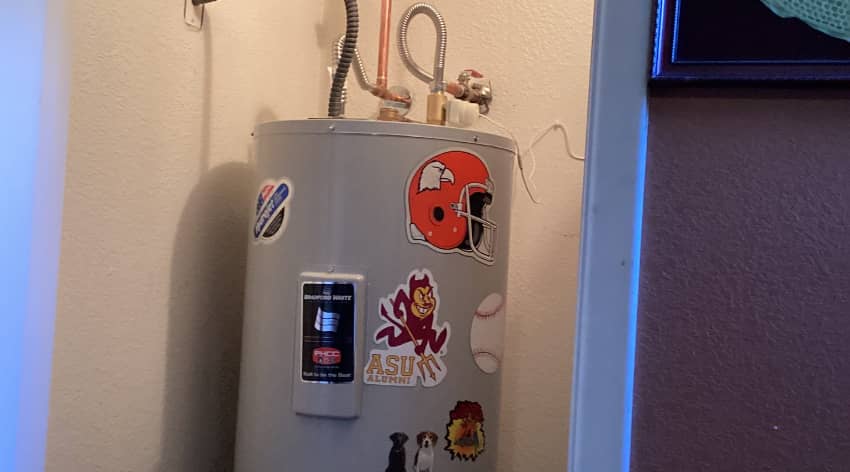
A water heater leaking from the top is a problem, but it does not always mean the tank itself has failed. In some cases, the leak may be coming from a connection, valve, or nearby plumbing component.
Possible causes include a loose cold-water inlet connection, a loose hot-water outlet connection, corrosion around fittings, a faulty temperature and pressure relief valve, or water dripping from nearby plumbing onto the top of the unit. Sometimes, what looks like a water heater leak may actually be condensation or a leak from another pipe above the unit.
A top leak may be repairable if the problem is limited to a fitting, valve, or plumbing connection. However, any leak should be inspected promptly. Water can damage nearby flooring, drywall, and electrical components, and a small leak can become a larger problem if ignored.
A leak from the tank itself is more serious. If the internal tank has corroded, repair may not be possible. This is why identifying the source of the leak matters before assuming the water heater needs to be replaced.
Maintenance Helps Extend Water Heater Life in Mesa
Routine maintenance can help your water heater last longer and perform more reliably even with the hard water coming in to your home in Mesa. For tank water heaters, flushing helps remove sediment before it builds up heavily at the bottom of the tank. For tankless water heaters, descaling helps clear mineral buildup from the heat exchanger and internal waterways.
During water heater repair or maintenance, a plumber can also clean your unit and check internal components for signs of wear. For example, the anode rod in a tank water heaters helps protect the from corrosion, but it wears down over time. If it is depleted, the tank can rust or break.
If your Mesa water heater is leaking from the top, making noise, struggling to keep up, or nearing the end of its lifespan, call George Brazil for professional water heater service. How long water heaters last is directly correlated to how well you take care of them. Extend the lifespan of your water heater by getting regular flushing, descaling, and maintenance.