
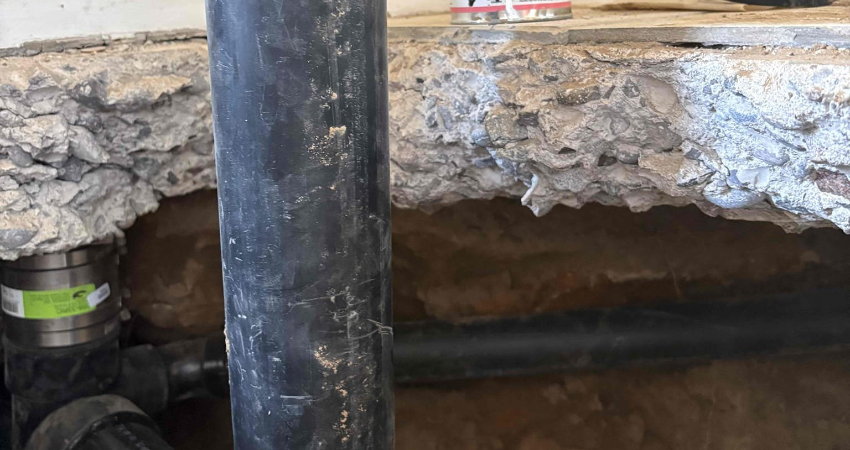
Repeatedly clearing a sewer line likely won’t solve the problem long-term, especially if the pipe itself is damaged, badly deteriorated, partially collapsed, or no longer has the proper slope. In a slab home, the situation can be more complicated because some drainage piping may run beneath the concrete foundation.
At that point, main sewer line replacement or repair of the affected section may be necessary to address the underlying problem.
Why Does a Sewer Keep Clogging After It’s Cleared?
Clearing a sewer removes an obstruction and restores flow, but it doesn’t fix any problems that are under your slab already.
For example:
- A separated joint may create an edge that repeatedly catches debris.
- Roots can enter through cracks or openings and return after they’re removed.
- Deterioration can reduce the usable interior of the pipe.
- A partial collapse can physically restrict wastewater flow.
In these cases, the clog is the symptom. The damaged pipe is the underlying problem. That’s why the same sewer can work normally immediately after cleaning, only to start slowing or backing up again later.
What Is a Sewer Line Belly?
Residential sewer lines use gravity to move wastewater and solids toward the municipal sewer. To do that effectively, the pipe needs to maintain the appropriate slope. A sewer line belly is a section of pipe that has sagged or settled below its intended grade. Instead of wastewater continuing downstream, some can remain in the low section. Solids may settle there as well, creating conditions for recurring buildup and blockages.
Cleaning equipment may remove accumulated material and temporarily improve drainage, but it can’t restore the slope of a sagging pipe. True sewer line belly repair requires correcting the physical problem with the affected section.
How Do You Know When Clearing Isn’t Enough?
What happens after a sewer is cleared can provide useful information.
| What Happens After Clearing | What It May Suggest |
| Drainage returns and stays normal | An isolated obstruction may have been resolved |
| The same problem repeatedly returns | An underlying pipe condition may be involved |
| Debris collects repeatedly in one location | Damage or pipe configuration may contribute |
| Camera inspection reveals a significant belly | Cleaning can’t correct the pipe’s grade |
| Camera encounters a collapsed section | Physical repair may be necessary |
Repeated clogs don’t automatically mean you need main sewer line replacement. They do indicate that it may be time to investigate why the problem keeps returning rather than simply clearing the line again.
Why Are Sewer Repairs Different in Slab Homes?
When a sewer pipe is buried in the yard, reaching it and determining repair options is relatively straightforward. A pipe beneath a home’s concrete slab introduces additional considerations.
Depending on the plumbing layout, accessing an under-slab sewer can involve flooring, concrete, cabinetry, walls, or other finished areas of the home. A failed section beneath a bathroom presents different challenges from a problem located outside the foundation.
That makes accurate diagnosis especially important. Before opening a slab, a plumber needs to determine exactly where the problem is located and how much of the sewer is actually affected. Camera inspection and other diagnostic techniques can help establish the scope before repair decisions are made.
Does the Whole Sewer Line Need to Be Replaced Under the Slab?
If inspection reveals one isolated damaged section while the remaining sewer is in good condition, targeted repair may be possible. More widespread deterioration, multiple failures, extensive damage, or other significant problems can make broader replacement a consideration.
Can You Fix a Sewer Line Belly Without Correcting the Pipe?
Because a true belly is a physical change in the pipe’s grade, removing the material collected inside it doesn’t eliminate the low spot. Cleaning or other methods may restore flow temporarily, but wastewater can begin collecting in the same location again. Sewer line belly repair typically requires accessing the affected area and repositioning or replacing piping so it has the proper grade.
When the problem is beneath a slab, it may mean accessing the sewer line through the slab.
What Does Sewer Line Replacement Cost?
According to the City of Mesa, repairs to private sewer laterals can range from hundreds to thousands of dollars depending on the problem. However, it depends on the complexity and location. A clean out and minor repair might be on the lower end of the costs, while a main sewer line replacement under a slab can cost between $6,000 and $25,000 depending on:
- Location and depth of the pipe
- Amount of piping involved
- Existing pipe condition
- Opening through slabs or floors
- Restoration work after repairs are completed
Find the Failure Before Deciding on Replacement
A sewer that repeatedly backs up doesn’t automatically need to be replaced from end to end. The important step is finding out why clearing isn’t providing a lasting solution:
- An isolated defect may call for localized repair.
- A belly may require correcting the grade of one section.
- Multiple failures or extensive deterioration can point toward a larger project.
Especially in a slab home, determining the location and extent of the problem before starting work can help avoid unnecessary disruption while ensuring that the actual failure gets addressed.
If repeated sewer clearing is no longer solving the problem at your East Mesa home, contact George Brazil to evaluate the line and determine whether repair or main sewer line replacement is the appropriate next step.