
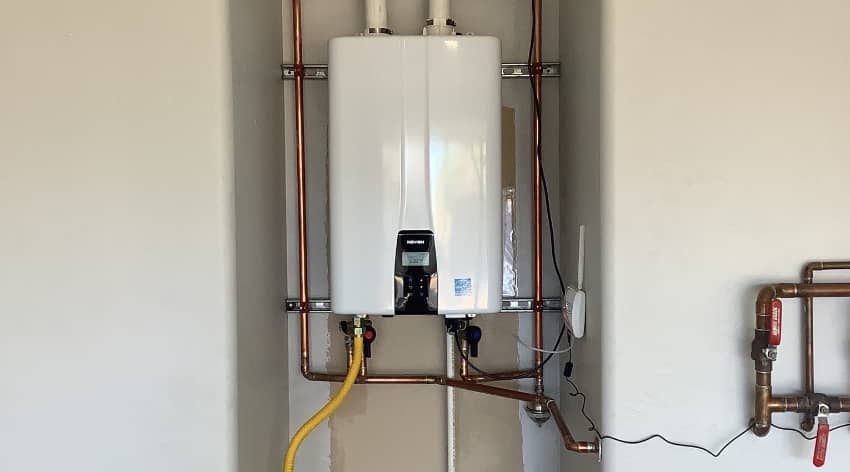
About half of the water in Mesa comes from the Colorado River through the Central Arizona Project (CAP). Another 40% is from the Salt River Project (SRP), and about 8% comes from wells. All of this water flows through mineral-rich Arizona soil, so by the time it’s treated and gets to your home, the water’s considered very hard. While it’s safe to drink, it can be rough on tankless water heaters, especially if you’re not descaling and servicing them regularly.
Tankless water heaters are a popular choice for Mesa homeowners because they save space and heat water on demand. Instead of storing hot water in a tank, they activate when you turn on the tap, take a shower, or start your washing machine. That design can be efficient and convenient, but it also means water is constantly moving through the internal parts.
In a hard-water area like Mesa, that matters. The same minerals that leave that chalky-looking buildup on your faucet or showerhead or spots on your glasses, can reduce performance, trigger error codes, and make your water heater work harder than it should.
Mesa’s Hard Water and Tankless Water Heaters
Hard water contains dissolved calcium and magnesium. When you heat up water, those minerals can separate from the water and form scale. In a traditional tank water heater, minerals often settle at the bottom of the tank. In a tankless water heater, scale can collect inside the heat exchanger and pipes. That is one reason tankless systems need special attention in Mesa.
Tankless units are designed to heat water quickly as it passes through the system. The internal pathways are smaller and more sensitive than a large storage tank. Even a thin layer of scale can interfere with water flow and heat transfer.
If you’re comparing a traditional tank water heater or a heat pump water heater vs. tankless, a tankless water heater is a great option in Mesa, but you’ll need to do regular maintenance to avoid damage from the hard water we have throughout the Phoenix area.
How Scale Builds Up Inside a Tankless Water Heater
A tankless water heater starts working when you turn on the hot water in your home. Cold water enters the unit, passes through the heat exchanger, and s heated on demand. As that mineral-heavy water heats up, calcium and magnesium can cling to hot internal surfaces. At first, the buildup may be minor. But with regular use, especially in a busy household, that scale will continue to thicken.
To avoid hard water buildup, you need to flush your system by descaling regularly.
What Happens If a Tankless Water Heater Is Not Descaled
If scale restricts water flow, your system may not heat properly or may shut down to protect itself. Over time, this can damage the unit. You may notice some of these common problems first:
- Water takes longer to heat up than normal.
- There’s reduced water flow.
- Temperatures fluctuates.
- Water starts hot, then goes cooler.
- Error codes on the unit.
- Louder than normal sounds during operation.
In more severe cases, scale buildup can damage your heat exchanger, and that’s one of the most expensive parts of a tankless water heater. Regular descaling helps remove mineral buildup before it causes bigger performance problems.
How Often to Flush Water Heater Systems in Mesa
Homeowners often ask how often to flush water heater systems, but the answer depends on whether you have a traditional tank vs. heat pump water heater vs tankless type. In areas where there’s hard water, like in Mesa, it’s recommended to flush your tank water heaters every six months to a year, draining them from the bottom of the tank. For tankless units, you need to flush and descale them to clean the heat exchanger at least once a year.
These are general guidelines. If you use a lot of water or have a large home, you may need to do so more often. Regular maintenance can extend the lifespan of your water heater, and it may be required under your water heater’s warranty, so check the manufacturer’s guidelines for how often to flush your water heater system at your home.
If your Mesa tankless water heater has not been descaled recently, is showing error codes, or is struggling with hard water buildup, call George Brazil for professional tankless water heater service.