
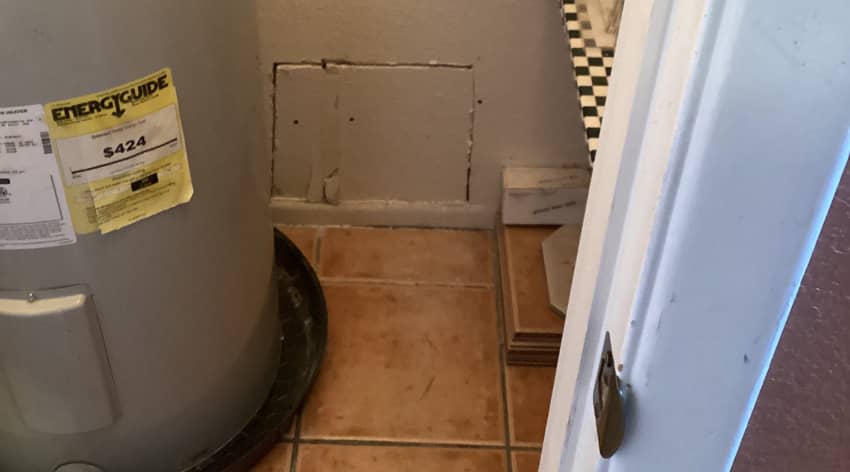
You’re walking across your living room or bathroom in the middle of one of our hot Arizona summers and you’ve got the air conditioning running. But when you step onto a patch of tile or carpet that feels strangely warm. You move a bit, and things are back to normal, but this odd hot spot remains in place.
Don’t ignore this. It’s often the first warning sign that you have a hot water leak under the slab, and it’s crucial that you get it fixed as soon as possible. Catching the warning signs early is essential to protect your home’s structural integrity.
Hot Water Lines Are Frequent Targets for Leaks
A hot water line is significantly more prone to underground structural failure than a cold water line because of thermal expansion and contraction. Every time a member of your household turns on a hot shower, washes dishes, or runs a load of laundry, hot water flows through the pipes under your floor In most Gilbert homes, these are copper pipes, which expand with the heat. When the faucet turns off and the line cools down, the metal contracts.
Because these lines are buried directly in the earth or encased in a concrete slab, this constant expanding and contracting causes the pipe to continuously rub against the rough desert soil and concrete surrounding it. Over several years, this friction wears down the copper walls from the outside, creating thin, structural weak spots that eventually burst under pressure.
Warning Signs of a Hot Water Leak Under Your Slab
Because a hot water line leak constantly bleeds thermal energy into the surrounding concrete foundation, it leaves behind several clear warning signs, such as:
- Hot spots on the floor: A particular area of your floor feels warm or hot to the touch.
- Rapid water heater cycling: Your water heater seems to be constantly running, firing up, or making a faint whistling sound even when nobody in the house is using hot water.
- Running out of hot water quickly: Your morning showers turn lukewarm or cold significantly faster than they used to because heated water is continuously escaping beneath the home.
- Unusually warm baseboards: The baseboards or lower portions of walls located near your water heater line or bathroom plumbing manifolds feel distinctly warm or even damp to the touch.
How to Detect a Water Leak Under a Slab
If you see the signs, you need to figure out how to detect a water leak under the slab. Here are a few tests you can start with.
Analyze Your Seasonal Water Usage
According to the Environmental Protection Agency (EPA), one of the easiest ways to figure out whether you have a look is to check your historic water use levels. You can check statements or go online at your utility company’s website and compare against prior years. The EPA recommends taking a look at your water usage during a colder month, such as January or February. If a standard family of four exceeds 12,000 gallons of water usage per month during time, there could be hidden leaks occurring on the property.
Perform the Two-Hour Water Meter Test
The EPA also suggests this two-hour test:
- Stop water usage: Turn off every single water-consuming appliance inside and outside your home. Ensure nobody uses a faucet, flushes a toilet, or runs the dishwasher, and make sure your outdoor landscaping irrigation is completely off.
- Check your outdoor meter: Locate your outdoor water meter box (usually found near the front property line). Open the lid, wipe away any dirt, and write down the exact numbers on the odometer, or take a picture of the dial with your phone.
- Wait It Out: Leave the water completely untouched for a full two-hour period.
- Check for Movement: After two hours, check the meter dial again. If the meter numbers or the triangle location have changed at all, you probably have a plumbing leak.
The Arizona Municipal Water Users Association (AMWUA) has a more thorough walkthrough of how to detect a water leak under a slab or elsewhere in your home. If you’re uncertain about how to locate your water meter or read the dial, you can check out the step-by-step guide.
Call for Professional Service
A DIY water meter test can help you figure out that you have a leak, but it won’t tell you where the leak is located. Locating the exact square inch of a hidden pipe break requires professional diagnostic equipment.
At George Brazil Plumbing & Electrical, our highly trained technicians utilize thermal imaging cameras, electronic acoustic listening devices, and other advanced techniques to find the exact spot where the leak occurs. This helps isolate the cause, making it easier to find, fix, and limit repairs.
Call George Brazil today to schedule a professional leak detection service and keep your Gilbert home safe.