
You wake up in the middle of the night to a faint, mysterious hissing sound behind your bathroom wall, or perhaps you open your monthly utility statement only to find a sky-high spike in your water bill. You may have a plumbing problem.
If your home was built before the mid-90s, there’s a pretty good chance you’ve got copper plumbing. Over time, these copper lines can develop tiny, needle-sized punctures. You may not notice them, but they can waste thousands of gallons of water, rot your structural wood studs, and breed hazardous mold behind your drywall.
We’ll explain what causes pinhole leaks in copper plumbing and the warning signs you need to look out for.
What Causes Pinhole Leaks in Copper Plumbing?
Here are some of the biggest contributors to pinhole leaks.
Gilbert’s Hard Water
The primary threat to your home’s plumbing system comes directly out of the tap. Gilbert is well-known for having extremely hard water, heavy concentrations of dissolved minerals like calcium and magnesium. Although treated so it’s safe to drink, these minerals can coat the insides of your copper pipes and trigger a chemical process known as pitted corrosion.
Instead of wearing down the entire pipe evenly, the chemical reaction targets tiny spots, gradually stripping away the copper’s protective internal lining. Eventually, the structural wall gives out entirely, resulting in a pinhole leak in a copper pipe that can be incredibly difficult to locate without specialized equipment.
Shifting Desert Soils and Monsoons
While water chemistry attacks your plumbing from the inside, the unique geology of our region exerts immense physical stress from the outside. The ground your home is built on is in constant motion, according to the Arizona Geological Survey. The clay in our soil swells when exposed to moisture and shrinks during out long, hot dry spells.
For Gilbert homeowners, this geological movement is a frequent catalyst for plumbing failures. During intense summer monsoon moisture, the swelling earth pushes against buried water lines. When the weather turns dry and hot, the soil pulls back. This constant shifting subjects rigid copper pipes, especially those buried beneath your concrete foundation, to significant friction and bending. As the pipe rubs against rocks and concrete under the slab, external weak spots are created, accelerating the breakthrough of a costly slab leak.
High Water Pressure
In addition to chemistry and geology, the physical mechanics of your plumbing system can speed up pipe degradation. If your home’s water pressure is set too high (above 80 PSI), or if your plumbing system features sharp bends and tightly packed fittings, it creates intense internal water turbulence, which can act as liquid sandpaper.
As the water rushes around sharp corners at high speeds, it mechanically erodes the inner walls of the pipe. Coupled with the hard water we have in the Valley, a weak spot can turn into a pinhole leak in a copper pipe over time, especially in hot water pipes where heat accelerates the scale that forms inside.
The Warning Signs to Look For
Pinhole leaks are so small, so you rarely see big pools of water. Instead, they cause slow, hidden damage. To catch them before they destroy your drywall or compromise your foundation, watch for these common red flags:
- Big jumps in water usage: A sudden spike in your water bill when your household routines haven’t changed.
- The sound of running water: A faint dripping, trickling, or hissing sound behind your walls when all faucets are completely turned off.
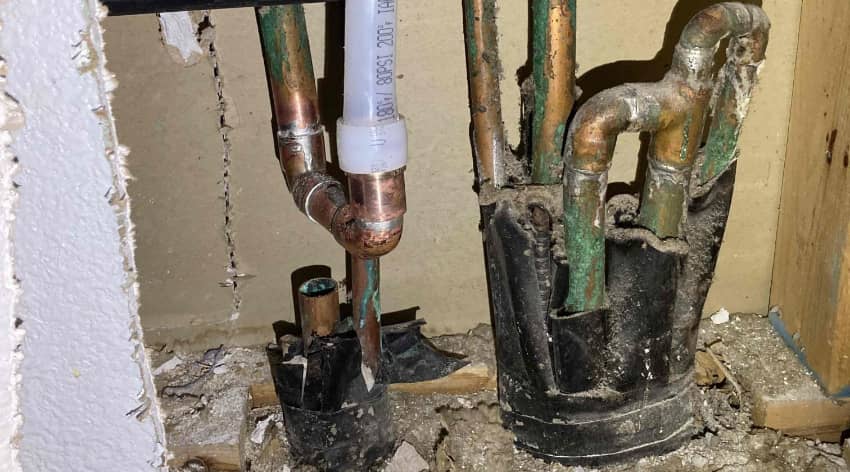
- Blue-green staining: Copper leaves behind a distinct teal or greenish oxidation color when it corrodes. Look for this staining on your drywall or around exposed pipe joints.
- Damp, warped, or warm Spots: Discolored drywall, bubbling paint, or a warm patch on your tile or carpeted floor.
- Musty odors: Stale smells in closets or cabinets that stick around.
Detecting Pinhole Leaks in Copper Pipes
If you see any of these warning signs or suspect you have a leak, don’t wait for the damage to spread. The experienced team at George Brazil Plumbing & Electrical uses advanced, non-invasive leak detection technology to pinpoint the exact source of the issue, including:
- Electronic listening devices to detect the sound of water escaping pipes
- Pressure testing to confirm line integrity
- Video camera inspection
- Infrared camera to identify temperature variations
- Moisture meters to detect hidden water accumulation
- Tracer gas detection when leaks are elusive
Contact us today to schedule an inspection. We offer same-day service and 24/7 emergency repairs.