
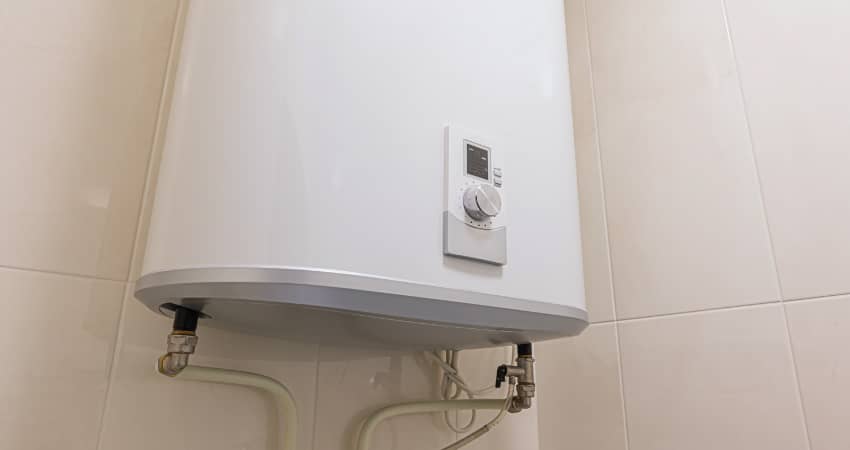
Hard water with high mineral content can be hard on hot water systems, especially if you’re not keeping up with routine maintenance and tank flushing. In Chandler and throughout the Phoenix metro area, hard water is prevalent and can produce sediment and scale on your tank or pipes. Even when systems are properly installed, components can fail and cause problems at the tap.
So, we’ve put together this troubleshooting guide to break down the most common problems with water heaters, plus a step-by-step solution for how to diagnose issues, how to turn off your electric water heater or gas water heater, and how to reset your hot water heater.
Before You Troubleshoot: Safety Rules to Prevent Bigger Damage
Working with a water heater can involve live electricity, gas combustion, hot water under pressure, and sharp sheet metal panels. So, before you troubleshoot, take a few precautions:
- If you smell gas, leave the area and call the gas company before calling a plumber.
- If you see water near electrical wiring or your breaker panel, do not touch the unit. Shut off power at the panel only if it is safe to do so.
- If the relief valve is actively discharging or water is spraying, shut off the cold-water supply to the heater and call for help.
- Do not repeatedly reset breakers or high-limit switches. If you have to keep resetting, there’s a fault somewhere in your system that needs attention.
How to Use This Troubleshooting Guide
Start with the symptom that best matches your situation. Identify whether your unit is gas or electric and then follow the flow for that symptom.
Do you Have a Leak?
- Yes → Go to “Water Heater Leaking: Identify the Source First”
- No → Continue
No Hot Water or Inconsistent Water Temperature?
- Yes → Go to “No Hot Water or Inconsistent Water Temperature”
- No → Continue
Is Your Unit Shutting Off, Tripping, or Resetting?
- If the unit turns off by itself → Go to “Why Does My Water Heater Keep Turning Off?”
- If the circuit breaker is tripping → Go to “Why Does my Water Heater Breaker Keep Tripping?”
- If you need to reset your unit → Go to “How to Reset Hot Water Heater Safely”
Is the Water Supply Shut Off or Is There an Emergency Situation?
- Yes → Go to “How to Turn off an Electric Water Heater During Emergencies and Shutoffs” or “How to Turn off a Gas Water Heater During Emergencies and Shutoffs”
Water Heater Leaking: Identify the Source First
Leaks are best diagnosed by location. Dry the exterior of the tank, then watch where moisture returns. Use a paper towel to confirm the highest point where water appears.
Water Heater Leaking from the Top
Top leaks usually involve:
- Cold inlet or hot outlet connections
- Corroded nipples or fittings
- A failing expansion tank connection
- Relief valve discharge that runs along piping and drips at the top
If you see water at the top, you shouldn’t automatically assume the tank has failed. Many times, water leaking from the top is due to connection issues, which are repairable.
Hot Water Heater Relief Valve Leaking
The relief valve is designed to release water if either the temperature or pressure gets too high for safety reasons and to protect your equipment. If your hot water heater relief valve is leaking, it usually means:
- Excessive incoming water pressure
- Failed expansion tank
- Defective or aging relief valve
- Overheating conditions exist
When there’s a hot water heater relief valve leaking, one common mistake is replacing the valve without fixing the underlying cause. The problem’s not solved, and the new valve will likely leak again.
Water Heater Pipe Fix Scenarios
Many leaks come from pipes or connections, such as:
- Threaded joints that loosen over time from heat cycling
- Galvanic corrosion where dissimilar metals connect
- Flexible connector failures
- Shutoff valve seepage at the packing nut
A proper water heater pipe leak fix includes identifying whether the leak is at a joint, a valve, a connector, or the tank itself. If the tank body is leaking, that is typically not fixable and will require replacement.
| Leak Severity Guide | |
| Slow drip at a fitting | Usually serviceable, but should be addressed promptly |
| Active drip or spraying | Shut off water supply and call for service |
| Water appearing from under the tank jacket or seams | Possible tank failure, requiring replacement |
No Hot Water or Inconsistent Water Temperature
No hot water can mean two different problems: the heater is not producing heat at all, or it is producing some hot water, but not enough. So, if there’s no hot water at the faucet, it might be a problem with the power, ignition, high-limit shutdown, or a failed primary component. Hot water starts but turns cold may indicate a failed lower element (electric), sediment buildup, dip tube issues, or an undersized unit.
There are a few things you can check safely:
- Confirm the unit has power or a gas supply.
- For electric units, confirm the water heater breaker is on and not warm to the touch.
- For gas units, confirm the gas valve is open and check for a pilot light through the sight window (if applicable).
- Look for error codes if the unit has a display.
Follow These Steps for Electric Water Heaters
Step 1: Check for power
If other appliances on the same circuit are failing, the issue may be upstream at the panel.
Step 2: Check the high-limit switch
If the high-limit has tripped, there is usually an overheating cause, such as a thermostat failure or heavy scale on an element.
Step 3: Evaluate the likely failed part
Upper thermostat or upper element failures tend to result in no hot water. Lower element failures tend to cause short-duration hot water.
A licensed technician can confirm with electrical testing, but the symptom pattern often narrows the likely cause quickly.
Follow These Steps for Gas Water Heaters
Step 1: Pilot and ignition
If the pilot will not stay lit, the thermocouple or flame sensor is often the root cause. If the pilot appears stable, but the burner doesn’t run, the gas control valve may be failing or set incorrectly.
Step 2: Combustion airflow
Dust and lint buildup can disrupt combustion. In Chandler, AZ, drafts and high temperatures can trigger shutoffs to protect your water heater from overheating.
Repair Solutions
Repairs may take several forms, including:
- Replacing heating elements or thermostats in electric units
- Replacing thermocouples or flame sensors in gas units
- Removing sediment and flushing for tank or tankless water heaters
Why Does my Water Heater Keep Turning Off?
If you’re wondering, “Why does my water heater keep turning off?”, it’s almost always because there’s a safety problem. Your unit shuts off to prevent overheating or further damage.
| Common Causes for Gas Units | Common Causes for Electric Units |
| Weak thermocouple or failing flame sensor causing gas shutdown | High-limit switch tripping due to thermostat failure |
| Overheating due to restricted airflow or scale on the tank bottom | Loose wiring that heats under load and triggers protective shutoff |
| Venting issues that trigger safety controls | Element overheating due to scale insulation |
| Gas control valve faults | Control board issues on advanced units |
Does your water heater turn off and won’t restart until it’s reset?
It’s likely a high-limit or safety lockout.
Does your water heater turn off intermittently, but then recover?
Look for overheating, airflow issues, or failing electrical components. If your heater works properly for a period and then begins turning off more frequently, scale buildup is a prime suspect.
Does your water heater turn off during heavy use?
This is typically scale or heat transfer issues, undersized capacity, or failing components.
A professional can confirm whether the issue is combustion-related (gas), electrical and control-related (electric), or mechanical and scale-related.
Why Does My Water Heater Breaker Keep Tripping?
The answer to “Why does my water heater breaker keep tripping?” is that there’s a safety problem. Circuit breakers are designed to prevent short circuits or overheating, so when breakers keep tripping, there are underlying problems that need attention.
Common causes include:
- Grounded heating element that leaks current to the tank
- Damaged wiring or loose connections at the water heater
- A failing breaker that trips prematurely
- Overload due to incorrect circuit sizing or shared loads
If a breaker trips immediately when a unit is powered on, there’s likelyashort circuit, severe wiring fault, or a badly grounded element. If it works for a while and then trips after a few minutes, you might have a circuit breaker that’s failing, a fault in an electrical element, or overheating in the unit.
Circuit breakers that trip only when there’s high demand usually indicate there’s an overload. While most homes in the Phoenix area are newer, circuit overloads are more common in older homes that may lack dedicated circuits for hot water heaters.
How to Reset a Hot Water Heater Safely
You can reset your hot water heater, but only when you understand why the safety device tripped. On many electric units, the reset button is the high-limit switch. It trips when temperatures exceed safe limits.
Here’s a step-by-step guide for how to reset hot water heater safely:
- Turn off the power at the breaker.
- Remove the upper access panel to locate the red button.
- Press the reset button firmly until it clicks.
- Replace insulation and the access panel.
- Turn power back on and monitor operation.
If you can’t push the button in or it requires repeated resets, thisusually indicates thermostat failure, element overheating due to scale, or wiring issues. Don’t keep resetting your unit. It can worsen the damage.
How to Turn off an Electric Water Heater During Emergencies and Shutoffs
Turning off the heater is essential whenever the water supply is interrupted or there is an active leak. You’ll want to shut down your system is the water is off to your home, there’s a major leak, or if you’re leaving home for an extended period and want to reduce risk.
Follow these steps for how to turn off an electric water heater safely and restart when needed.
Electric Water Heater Shutdown Sequence
- Turn off the power at the breaker first.
- Shut off the cold-water supply valve to the heater.
- If needed, open a hot water faucet to relieve pressure.
- For active leaks, keep the area clear of electrical cords and devices.
Electric Water Heater Start-up Sequence
- Restore the water supply first and purge air by opening a hot faucet.
- Confirm the tank is full.
- Restore power at the breaker.
Don’t restart the power until you’re sure the tank is full to prevent burning out components.
How to Turn off a Gas Water Heater During Emergencies and Shutoffs
To safely turn off your gas water heater, turn the thermostat dial to off, shut off the gas supply valve, and close the cold water inlet valve to stop the water flow. If you smell gas at any point, stop and call for help immediately.
If you need an emergency plumber in Chandler, AZ, contact George Brazil Plumbing & Electrical for emergency service.
When a Water Heater Problem Becomes an Emergency
Call for urgent service if you have:
- Active leaking or spraying water
- Burning smells, scorched wiring, or repeated breaker trips
- Gas odors or suspected combustion issues
- No hot water in situations where it affects health, safety, or caregiving
FAQs – Frequently Asked Questions
Is a small drip on top of the water heater always a tank failure?
No. A water heater leaking from the top is usually caused by fittings, nipples, or relief valve discharge tracking along piping. The source must be confirmed before assuming replacement is required.
How many times should I reset my water heater before I stop?
Once is reasonable after a power event. If the reset trips again, stop resetting and schedule diagnosis to avoid overheating damage.
Why does my breaker trip only sometimes when the water heater runs?
Intermittent trips often point to failing elements, overheating wiring or a weakened breaker.
What should I do first if my water heater is leaking or the water is off?
Turn off the power at the breaker first, then shut off the water supply to prevent dry-firing and reduce electrical risk.
You can rely on George Brazil Plumbing & Electrical for professional water heater service, repair, and replacement. We’ve been serving customers for more than 70 years with fast, reliable, and professional service, and we can handle all of your plumbing and electrical issues. If you need an emergency plumber in Chandler AZ or throughout the Phoenix metro, call us right away. You can also schedule service now.