
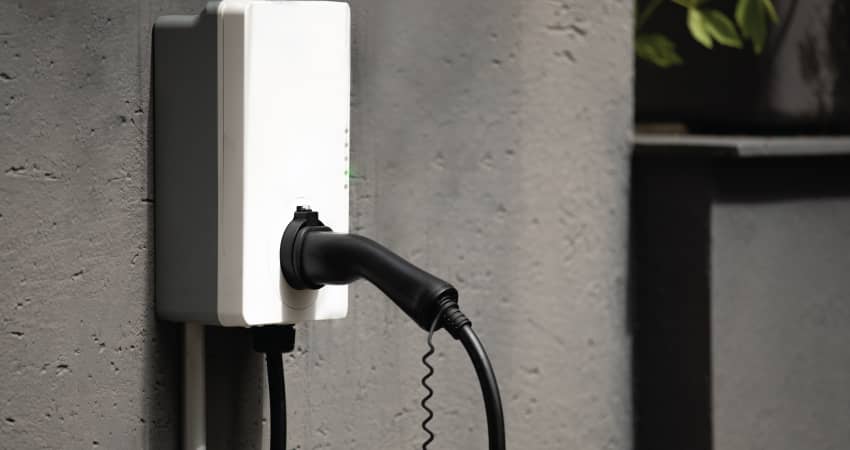
Electric vehicle ownership continues to accelerate across Arizona, and Mesa homeowners are increasingly planning for home charging. According to statewide registration data, there are now more than 128,000 electric vehicles registered in Arizona, among the highest in the nation.
If you’re thinking about joining the ranks, you may have questions about EV charger installation. No worries! This guide will help you understand:
- Your options for EV charging
- The cost to install an EV charger at home
- Code requirements
- Rebates and incentives
- Why this is not a DIY project
Your Home EV Charging Options
When you want to install an EV charger at home, you have two realistic options:
- Level 1 EV charger
- Level 2 EV charge
Level 1 chargers use standard 120-volt household outlets but provide extremely slow charging. It can take 24-48 hours to get close to a full charge, so this option is really not practical if you’re doing any significant driving beyond very short trips.
Level 2 chargers operate on higher-voltage electrical service and deliver significantly faster charging. For most Mesa homeowners, Level 2 charging offers the convenience and flexibility you need. You can typically keep your electric vehicle plugged in overnight at home and wake up to a full charge in the morning.
Here’s how Level 1 and Level 2 EV charge installations compare:
| Feature | Level 1 EV Charger | Level 2 EV Charger |
| Voltage Required | 120-volt standard household outlet | 240-volt dedicated circuit |
| Typical Charging Speed | Very slow | Significantly faster |
| Miles of Range Added per Hour | 3–5 miles | 20–40+ miles, depending on your EV’s battery |
| Time to Fully Charge an EV | 24–48+ hours | 4–10 hours |
| Best For | Short commutes, low daily mileage | Daily drivers, larger batteries, multiple EVs |
| Electrical Panel Impact | Minimal if outlet is dedicated | Moderate to significant depending on panel capacity |
| Dedicated Circuit Required | Recommended | Required |
You may also hear about Level 3 chargers. These are typically reserved for public or company charging stations, which provide the fastest charging option. There are about 250 public EV charger installations near you within a 10-mile radius of Mesa, but they aren’t practical for home install. They require major infrastructure, often including upgrades to the electrical grid, and can cost $50,000 or more.
Choosing the Right EV Charger for Your Mesa Home
Choosing the right type of home EV charger installation is just the first step, however. There are electrical code requirements, load calculations to do, and integration into your electrical system for a safe and compliant installation.
Electrical Requirements for EV Charger Installation
EV chargers interact directly with your home’s electrical infrastructure, so you have to make sure your electrical system can handle the extra load. Before installation, a highly trained electrician will evaluate your home’s electrical panel to determine whether you have the available capacity. Level 2 chargers require 30 to 60 amps of dedicated capacity, depending on the charger and vehicle, which means a dedicated circuit to avoid tripping breakers or overloading your system.
Unfortunately, most Mesa homes weren’t designed with EV charging in mind and require panel upgrades to meet code requirements.
240-Volt Circuit and Dedicated Breaker Requirements
Level 2 chargers require a dedicated 240-volt circuit. This circuit cannot be shared with other appliances and must be sized correctly for continuous electrical load. Meeting code requirements for a safe EV charger installation also requires you to have the proper breaker selection, wire gauge, grounding, and conduit routing.
Distance From Panel to Garage and Installation Complexity
The distance between your electrical panel and the charging location can also affect complexity, which impacts your material costs and the time it takes for an EV charger installation. If you have a dedicated outlet in the right place, the project is fairly straightforward. If you have to add outlets, install additional conduit, or upgrade your panel, it’s more complex.
If you have a detached garage, you might need more conduit, trenching, or a subpanel. If you want to install an EV charger at home on the outside, you may need different types of mounts to protect from the weather and additional safeguards, all of which increase your EV charger installation cost.
Hardwired vs Plug-In EV Chargers
You can also choose between a hardwired EV charger installation or a plug-in option. If you have a dedicated outlet, you can remove the plug-in charger or relocate it if needed. Hardwired chargers are permanently connected, while providing a cleaner, more durable installation.
A professional electrician can recommend the best option based on capacity and usage needs.
Cost to Install an EV Charger at Home
A home EV charger installation price includes labor, electrical materials, and any required panel or circuit upgrades. If your Mesa home already has sufficient infrastructure, you can expect costs to be lower. If you need upgrades, the EV charger installation cost will be on the higher end of the scale.
While installing an EV charger at home may seem like a simple project, there is a wide range of factors you have to take into consideration, and each can impact the final project cost.
| Electrical | Installation & Site | Administrative & Other |
| Charger Level Selected | Distance From Electrical Panel | |
| Electrical Panel Capacity | Garage Type and Location | Electrical Code Compliance Upgrades |
| Electrical Panel Age and Condition | Trenching or Underground Wiring | Utility Requirements or Restrictions |
| Need for a New 240-Volt Circuit | Wall Construction and Access | HOA or Community Requirements |
| Hardwired vs Plug-In Charger | Outdoor vs Indoor Installation | Arizona Heat Considerations |
| Load Calculation Requirements | Futureproofing for Additional EVs | Incentive Eligibility Requirements |
Are There Any EV Charger Rebates or Tax Credits?
When evaluating the cost to install an EV charger at home, understanding available incentives is important, but the real financial story goes beyond upfront rebates. For Mesa homeowners, the most significant savings come from how your charger interacts with Arizona’s time-of-use electricity rates.
Why Level 2 Chargers Save You Money Every Single Month
Arizona utilities, including SRP which serves much of Mesa, use time-of-use rate structures where electricity costs significantly more during peak hours. For most plans, peak rates apply from 5 AM to 9 AM and 5 PM to 9 PM when demand is highest.
Here’s where charger type makes a massive financial difference:
Level 1 chargers (120-volt standard outlets) charge so slowly that you’re forced to charge during these expensive peak hours. Even if you plug in at night, the slow charging speed means you’ll still be drawing power well into the morning peak period. For daily drivers, this means paying premium rates every single day you charge.
Level 2 chargers (240-volt dedicated circuits) charge 4-6 times faster, allowing you to fully charge your vehicle during off-peak hours when electricity rates can be 50-70% lower. By completing your charge between 11 PM and 5 AM during “Super Off-Peak Hours,” you avoid peak rates entirely.
Real-World Cost Impact:
If you drive 30 miles per day (typical for Mesa commuters), you’ll use approximately 10 kWh daily to recharge. Over a month, that’s 300 kWh.
- With Level 1 charging (forced into peak hours): 300 kWh × $0.30/kWh peak rate = $90/month
- With Level 2 charging (off-peak hours): 300 kWh × $0.10/kWh off-peak rate = $30/month
That’s $60 in monthly savings, or $720 per year. Over five years, Level 2 charging saves you $3,600 compared to Level 1, easily offsetting the higher installation cost and making Level 2 the clear financial winner.
Available Rebates and Tax Credits
While ongoing rate optimization provides the most substantial savings, upfront incentives can help reduce your initial investment:
Federal Tax Credits: Unfortunately, the federal tax credits for new and used electric vehicle purchases expired in 2025, so the $7,500 EV purchase credit is no longer available. However, there is a federal tax credit for EV charger installation called the Alternative Fuel Vehicle Refueling Property Tax Credit (30C), which provides up to 30% of costs or $1,000 maximum. This credit is available through June 30, 2026, but requires qualifying as a low-income household in a non-urban census tract. While several hundred areas within Maricopa County qualify, none are currently located in Mesa proper.
Arizona State Programs: Arizona does not currently offer state-level rebates or tax credits for residential EV charger installations.
Utility Company Incentives: SRP, which serves much of Mesa, offers two valuable programs:
- Super Off-Peak Rate Discount: Reduced electricity costs for homeowners who charge between 11 PM and 5 AM. You can install a programmable Level 2 charger to automatically take advantage of these rates without having to remember to plug in at specific times.
- One-Time $250 Rebate: Available for purchasing and installing a qualifying Level 2 EV charging station.
Other utility providers in the Mesa area may offer similar incentives, including discounts on monthly bills when you share charging data or commit to off-peak charging schedules.
Maximizing Your Savings
To get the most value from your home EV charger installation:
- Choose Level 2 to unlock off-peak rate savings that add up to thousands over your vehicle’s lifetime
- Install a programmable charger that automatically charges during Super Off-Peak hours
- Keep documentation of professional installation, permits, and inspections to qualify for any available utility rebates
- Check with your utility provider about current programs, as incentives change regularly
The combination of lower off-peak charging costs and available utility incentives makes professional Level 2 EV charger installation a smart long-term investment for Mesa homeowners.
Can I DIY a Home EV Charge Installation?
You might be considering DIY installation, but most EV charger projects will quickly exceed safe DIY limits once you understand the electrical requirements. Unlike other appliances, like washers and dryers, that are only used occasionally, EV chargers draw sustained electrical loads for hours at a time, which places continuous stress on circuits, breakers, and wiring.
DIY installation is usually limited to certain scenarios. For example, if you have an existing dedicated circuit that can accommodate Level 1 charging, you may be able to just plug in the connector that comes with your vehicle. However, you must still confirm that the outlet, circuit, and wiring are properly rated for continuous loads. In many Mesa homes, you won’t meet these conditions for safe operation without an upgrade.
Professional installation becomes mandatory as soon as the project involves adding a new 240-volt circuit, upgrading the electrical panel, or installing a hardwired Level 2 charger. These steps require permits, inspections, and precise load calculations. Trying to do it yourself is dangerous, and failed inspections and rework can be expensive.
There are some factors you might not think about when considering DIY:
- Most manufacturers require professional installation as part of their warranty coverage. DIY-it and you risk losing warranty protection for your charger or your vehicle’s electrical system.
- The same may apply to homeowner’s insurance. If you don’t have a professional installation, your homeowner’s policy may not cover you in case of an incident.
- Don’t forget about rebates or incentives. To qualify, you’ll typically need proof of professional installation, permitting, and inspections.
- You might have trouble if you ever decide to sell your home. You might not pass a home inspection without proper documentation.
Hiring a Qualified EV Charger Installer Matters
When you hire a professional EV charger installer, you get a licensed electrician trained on proper installation, local building codes, and National Electrical Code requirements for a safe and durable installation.
You’ll also get someone who is licensed, bonded, and insured to protect you in case there is any damage to your property or injury during EV charger installation or if any contractual obligations are not met.Unlicensed or improper installations can create serious downstream issues. Home inspections during resale may fail. Manufacturer warranties for EV chargers may also be voided if installation does not meet documented requirements.
Qualified EV charger installers also bring experience specific to EV infrastructure. They understand load calculations, panel limitations, local permitting processes, and how Arizona’s climate affects equipment performance.
Ultimately, hiring a licensed & bonded EV charger company is about accountability. It ensures the work is done correctly, documented properly, and built to perform safely for years to come.
FAQs—Frequently Asked Questions About EV Charger Installation in Mesa
How much does it cost to install an EV charger at home?
Installation cost varies based on electrical capacity, distance from the panel, and whether upgrades are needed. Homes with existing circuits cost less, while panel upgrades and new wiring increase the price.
Can my electrical panel handle a Level 2 EV charger?
Not all panels can support Level 2 charging without upgrades. A skilled electrician must perform a load calculation to determine if your panel has sufficient available capacity.
Is professional EV charger installation required?
Professional installation is required for new circuits, panel upgrades, and hardwired chargers. It also helps ensure code compliance, safety, and eligibility for rebates or tax credits.
In Mesa, you can trust George Brazil Plumbing & Electrical for safe, compliant, and affordable EV charger installation. Our team of licensed, bonded, and insured professional electricians will evaluate your electrical system and provide you with transparent, upfront pricing. Call today to schedule an appointment for a home EV charger installation.